Most of us have been there a misstep off a curb, an awkward landing during a weekend game, or a slip on the stairs. Your ankle rolls, it throbs, and it immediately starts to swell. For decades, the standard at-home response has been the same: dig the old beige crepe bandage out of the medicine cabinet, wrap it tightly around the ankle, and hobble around for a few days until it feels good enough.
But sports medicine has evolved, and we now know that a simple crepe bandage is a woefully inadequate strategy for healing an ankle sprain. In fact, treating a sprain as just a temporary inconvenience can lead to chronic pain and a high likelihood of reinjury.
Here is the truth behind the most common ankle sprain myths and what proper recovery actually looks like.
1. The Crepe Bandage Illusion
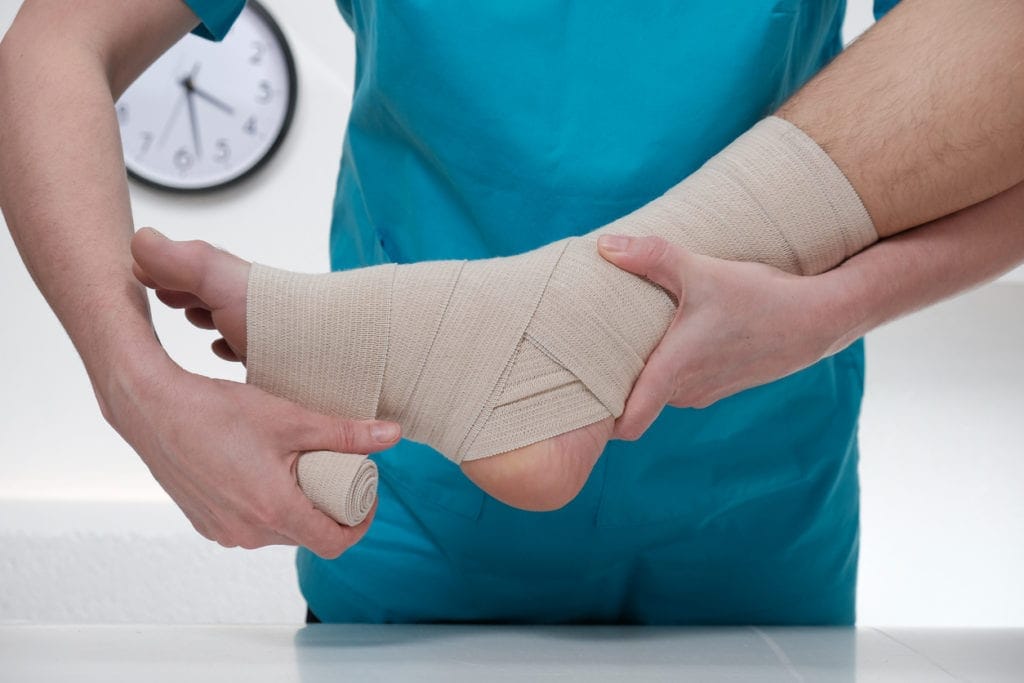
Let’s start by clarifying what a crepe bandage (often called an ACE wrap) actually does.
A crepe bandage provides mild compression. Compression is great for managing acute swelling in the first 24 to 48 hours after an injury. The physical presence of the wrap also serves as a helpful mental reminder to be careful with your foot.
However, a crepe bandage provides zero structural support.
When you sprain your ankle, you are stretching or tearing the ligaments, the tough bands of tissue that connect your bones and stabilize the joint. A stretchy piece of fabric does not act as a substitute for a damaged ligament. If you step on uneven ground wearing only a crepe bandage, your ankle will roll again just as easily.
2. Myths vs. Facts
Here are the most common traps people fall into when dealing with a sprained ankle:
Myth 1: I should rest completely until the pain is gone.
Fact: Absolute rest is actually detrimental to healing. While you should avoid bearing full weight on a severely sprained ankle in the first couple of days, prolonged immobilization makes the joint stiff and the surrounding muscles weak. Modern physical therapy encourages early, controlled mobilization. Moving the ankle safely promotes blood flow and helps the healing ligament fibers align correctly
Myth 2: If I can walk on it, it’s not that bad.
Fact: The ability to bear weight does not rule out a significant sprain or even a minor fracture. Adrenaline and individual pain tolerance can mask severe tissue damage. If there is significant swelling, bruising, or instability, it requires proper evaluation and a structured rehab plan, regardless of whether you can limp your way across the room
Myth 3: Once it stops hurting, it’s fully healed.
Fact: This is the most dangerous myth of all. Pain usually subsides weeks or even months before the ligament is fully structurally sound. More importantly, sprains damage the nerves inside the ligaments that communicate with your brain about your foot’s position in space (a sense called proprioception). Without retraining this system, you are highly vulnerable to re-spraining the ankle.
2. The Modern Blueprint for Recovery
If the crepe bandage and the couch aren’t the answer, what is? The sports medicine community has largely moved away from the old R.I.C.E. (Rest, Ice, Compression, Elevation) protocol in favor of a more comprehensive approach known as PEACE & LOVE.
Here is what proper, active recovery actually entails:
P.E.A.C.E. (The first 1-3 days):
Protect the joint (this is where crutches or a rigid brace come in).
Elevate to reduce pooling of fluids.
Avoid anti-inflammatories (inflammation is actually the first stage of tissue repair; suppressing it can delay healing).
Compress (this is the only time your crepe bandage is truly useful).
Educate yourself on active recovery rather than passive treatments.
L.O.V.E. (Days 4 and beyond):
Load the joint gradually. Let pain be your guide to slowly reintroduce weight.
Optimism conditions your brain for better recovery outcomes.
Vascularization means engaging in pain-free cardiovascular activity (like a stationary bike) to boost blood flow.
Exercise to restore mobility, strength, and proprioception.
4. The Crucial Missing Step: Proprioception
If you want to fully recover, you have to retrain your balance. When a ligament tears, the microscopic sensors inside it that tell your brain “we are tilting too far to the left” get damaged.
Have you ever noticed that once someone sprains their ankle, they seem to sprain it over and over again? It’s not because they have “weak ankles.” It’s because they never rehabilitated their proprioception. Proper recovery means doing targeted balance exercises like standing on one leg, using a wobble board, or performing single-leg reaches to wake those sensors back up.
The Takeaway
A crepe bandage is a tool for managing early swelling, not a magical healing device. If you’ve sprained your ankle, ditch the “tough it out” mentality. Seek out a physical therapist, get a proper brace if needed, and commit to the rehab exercises. Your ligaments will thank you.
Dr Ashay T.M
Consultant Arthroscopy and Orthopaedic surgeon
Prakriya Hospitals