A Lump Near the Belly Button? Here’s What You Need to Know
By Dr. Puneeth Thalasta, MS, MCh (Minimal Access Surgery, AIIMS New Delhi), FSGE (RGUHS) FIAGES, FALS
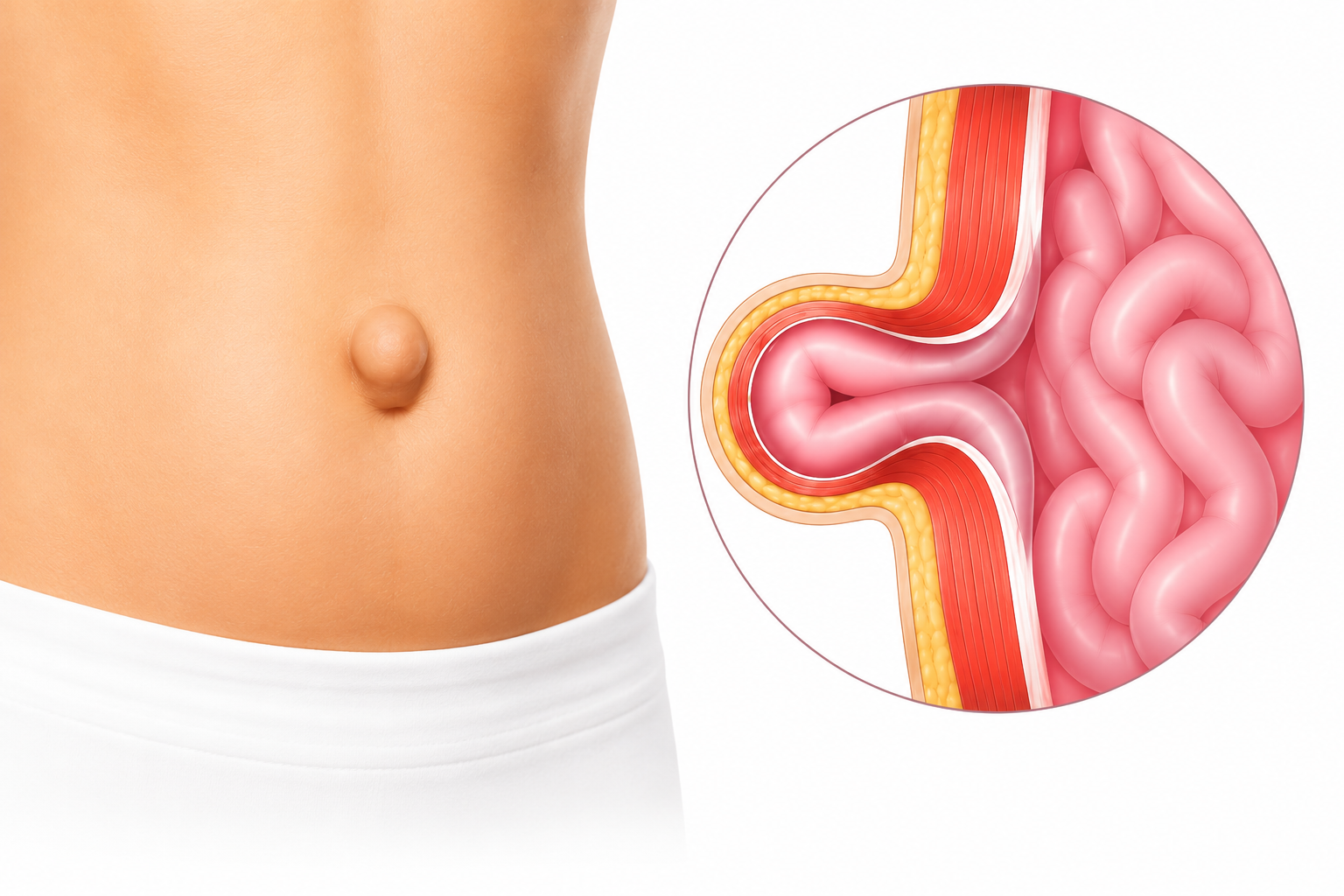
An umbilical hernia is a common condition in which tissue from inside the abdomen, such as fat or a portion of the intestine, protrudes through a weak spot in the abdominal wall near the belly button (umbilicus). While some hernias remain small and painless, others can enlarge over time and may lead to serious complications if left untreated.
The good news is that umbilical hernias can be treated safely and effectively with modern minimally invasive techniques, including laparoscopic and robotic surgery.
What Is an Umbilical Hernia?
An umbilical hernia occurs when there is a weakness or defect in the muscles around the umbilicus (belly button), allowing abdominal contents to bulge through.
Umbilical hernias are common in infants and often close naturally during childhood. In adults, however, they usually do not heal on their own and tend to increase in size over time.
Factors that increase the risk include:
- Obesity
- Pregnancy
- Repeated heavy lifting
- Chronic cough
- Constipation with straining
- Previous abdominal surgery
- Accumulation of fluid in the abdomen (ascites)
How Does an Umbilical Hernia Present?
The most common presentation is a soft swelling or bulge at or near the belly button. The swelling may:
- Become more noticeable while standing, coughing, or straining.
- Reduce or disappear when lying down.
- Gradually increase in size over months or years.
- Become uncomfortable after prolonged standing or physical activity.
What Are the Symptoms?
Many small hernias cause little or no discomfort. As the hernia enlarges, symptoms may include:
- A visible swelling at the belly button.
- Pain or discomfort around the umbilicus.
- A feeling of pressure or heaviness.
- Discomfort during coughing, bending, or lifting heavy objects.
- Difficulty performing strenuous activities.
Warning Signs – Seek Emergency Care
Seek immediate medical attention if you develop:
- Sudden severe pain over the swelling.
- A swelling that becomes hard and cannot be pushed back.
- Redness or discoloration of the skin.
- Nausea or vomiting.
- Abdominal distension.
- Inability to pass stools or gas.
These symptoms may indicate an incarcerated or strangulated hernia, where the blood supply to the trapped intestine is compromised. This is a surgical emergency.
How Is It Diagnosed?
Most umbilical hernias are diagnosed during a physical examination by a surgeon.
In selected cases, additional imaging may be recommended, such as:
- Ultrasound
- CT scan of the abdomen
- MRI (rarely required)
These tests help assess the size of the defect and identify the contents of the hernia, especially in large or recurrent cases.
What Is the Treatment?
Unlike some childhood umbilical hernias, adult umbilical hernias do not resolve on their own. Medicines, abdominal belts, or exercises cannot repair the defect.
The definitive treatment is surgical repair, which involves returning the protruding tissue to the abdomen and reinforcing the weakened abdominal wall, usually with a surgical mesh. Timely surgery prevents enlargement of the hernia and reduces the risk of complications.
Modern Surgical Options
Laparoscopic (Keyhole) Umbilical Hernia Repair
Laparoscopic surgery is performed through a few small incisions using a high-definition camera and specialized instruments.
Benefits include:
- Smaller scars.
- Less postoperative pain.
- Lower risk of wound complications.
- Faster recovery.
- Earlier return to normal activities.
- Particularly useful for larger or recurrent hernias.
Robotic Umbilical Hernia Repair
Robotic surgery is an advanced minimally invasive approach that provides the surgeon with enhanced precision, three-dimensional vision, and improved instrument control.
Potential advantages include:
- Precise closure of the abdominal wall defect.
- Better mesh placement.
- Minimal tissue trauma.
- Reduced postoperative discomfort.
- Faster recovery.
- Excellent option for complex, recurrent, or larger hernias.
Your surgeon will recommend the most suitable technique based on the size of the hernia, previous surgeries, your overall health, and individual needs.
Recovery After Surgery
Recovery following minimally invasive hernia repair is generally quick.
Most patients can:
- Walk within a few hours after surgery.
- Return home the same day or the following day.
- Resume light daily activities within a few days.
- Return to desk work within one to two weeks.
- Resume strenuous exercise and heavy lifting after 4–6 weeks, as advised by the surgeon.
Following your surgeon’s postoperative instructions and avoiding heavy lifting during the healing period are essential for a successful recovery.
When Should You Seek Medical Advice?
Consult a surgeon if you notice:
- A swelling at or near the belly button.
- Pain or discomfort around the umbilicus.
- A swelling that gradually increases in size.
- Difficulty reducing the swelling.
- Symptoms that interfere with your daily activities.
- Sudden pain, redness, or an irreducible swelling.
Early evaluation and planned surgery are safer than waiting for an emergency.
Take-Home Message
An umbilical hernia is a common condition that is unlikely to heal without surgery in adults. Early diagnosis and timely treatment can prevent complications and improve quality of life. With modern laparoscopic and robotic techniques, hernia repair is safe, minimally invasive, and associated with less pain, smaller scars, and a quicker return to normal activities. If you notice a swelling near your belly button, don’t ignore it—consult a surgeon for evaluation and appropriate treatment.
Dr. Puneeth Thalasta
MBBS, MS, M.Ch, FIAGES, FALS (HPB)
Consultant – General, GI and Minimal Access Surgery