Recognising precancerous lesions and early warning signs can make a life-changing difference
We use our mouth every day to eat, speak, smile and communicate. Yet, when something changes inside the mouth, it is surprisingly easy to ignore it.
A small ulcer is often dismissed as a “heat boil.” A white patch may be attributed to tobacco or food. A difficulty in opening the mouth may be considered insignificant. Unfortunately, some of these seemingly minor changes can be early warning signs of oral cancer or a potentially precancerous condition.
The good news is that the mouth is an easily accessible part of the body. Changes can often be seen and felt early. Recognising these warning signs and seeking timely medical attention can make a significant difference in treatment and outcome.
What is oral cancer?
Oral cancer is a cancer that develops in parts of the mouth such as the lips, tongue, gums, inner lining of the cheeks, floor of the mouth and roof of the mouth.
In India, oral cancer remains a major health concern. One of the most important reasons is the widespread use of tobacco and areca nut in various forms.
Smoking and chewing tobacco, gutkha, khaini and other smokeless tobacco products increase the risk of oral cancer. Equally important is areca nut or supari, which is sometimes mistakenly considered harmless when consumed without tobacco. Areca nut itself is a recognised carcinogen and is strongly associated with conditions that can precede oral cancer.
Alcohol, particularly when combined with tobacco, can further increase the risk.
Cancer may not appear suddenly.
Oral cancer does not always develop overnight. In some people, the lining of the mouth undergoes abnormal changes over time. These are known as oral potentially malignant disorders.
They do not mean that a person definitely has cancer. However, certain lesions have a higher risk of eventually developing into cancer and therefore require proper assessment and follow-up.
White patches – Leukoplakia
A persistent white patch inside the mouth that cannot be easily scraped away may be leukoplakia.
Many white patches are harmless, but some may contain abnormal or precancerous cells. A persistent white patch, especially in someone who uses tobacco or areca nut, should therefore not be ignored.
Red patches – Erythroplakia
A persistent red patch inside the mouth deserves particular attention. Red patches are less common than white patches but have a greater likelihood of showing significant abnormal changes.
A patch containing both red and white areas can also be concerning.
Oral submucous fibrosis
This is particularly important in India because of its strong association with areca nut chewing.
A person may initially experience burning while eating spicy food. Gradually, the tissues inside the cheeks become stiff and less flexible. The person may notice difficulty opening the mouth, difficulty eating certain foods or a feeling of tightness inside the cheeks.
This condition can progressively worsen and carries an increased risk of oral cancer.
The most important treatment is to stop areca-nut use completely and seek appropriate medical evaluation and follow-up.
What symptoms should you never ignore?
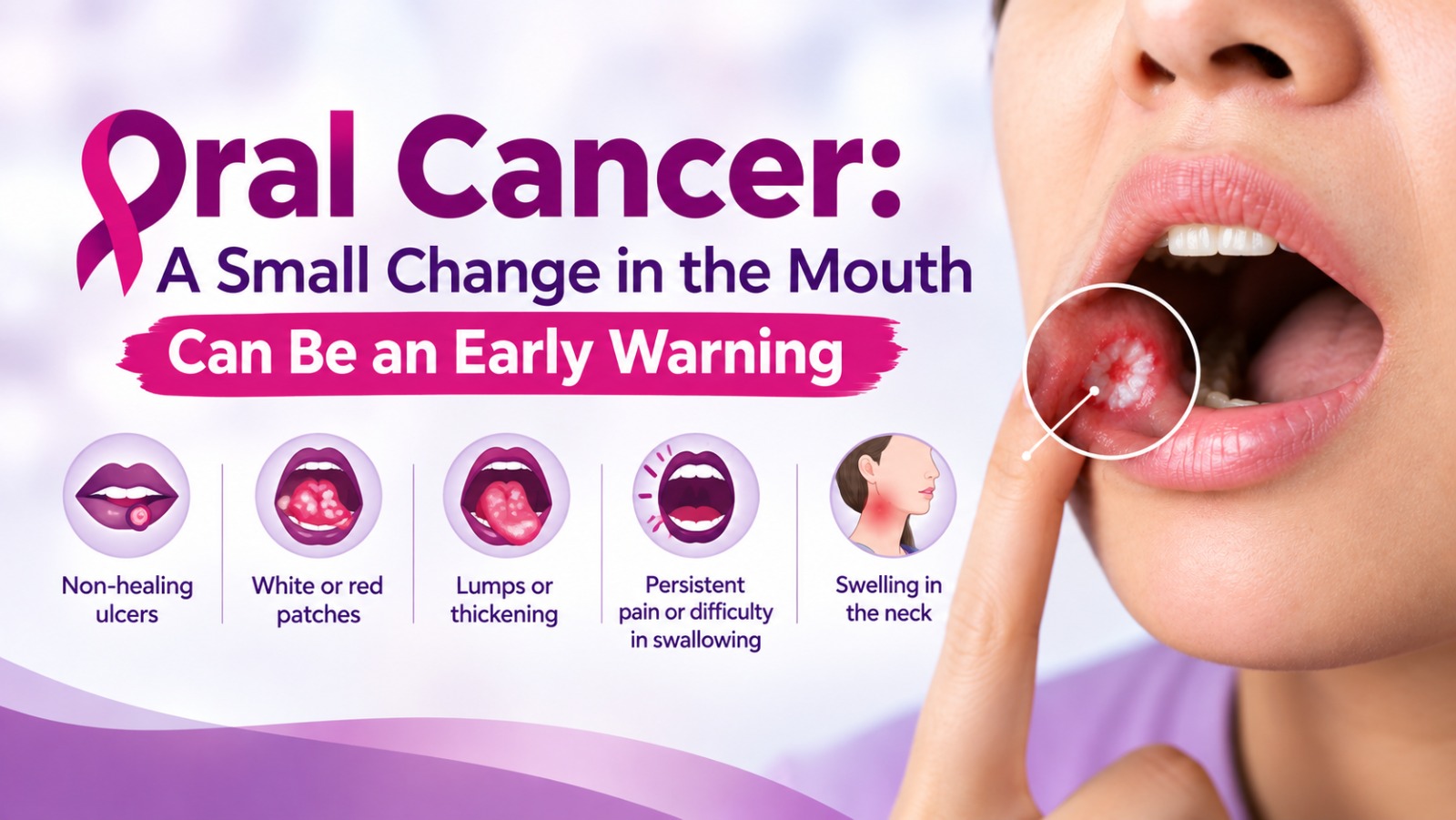
One of the most important warning signs is a mouth ulcer that does not heal.
Most ordinary mouth ulcers heal within a short period. But an ulcer, sore or abnormal area that persists for more than two weeks should be examined by a doctor or dentist.
Other warning signs include:
– A persistent white, red or red-and-white patch
– A lump or thickened area inside the mouth
– Recurrent ulceration in the same location
– Unexplained bleeding from the mouth
– Persistent pain or burning
– Numbness of the tongue, lip or other area of the mouth
– Difficulty chewing or swallowing
– Difficulty moving the tongue
– Increasing difficulty opening the mouth
– A tooth becoming loose without an obvious dental cause
– Dentures suddenly becoming uncomfortable or not fitting properly
– Persistent sore throat or a sensation of something stuck in the throat
– Unexplained weight loss
Importantly, oral cancer does not necessarily cause pain in its early stages. Waiting for pain before seeking medical attention can therefore result in a delay in diagnosis.
Don’t ignore a lump in the neck.
There is another warning sign that deserves special attention – a new lump or swelling in the neck.
The mouth drains through a network of lymphatic vessels into lymph nodes in the neck. When an oral cancer spreads, it can involve these lymph nodes.
A person may notice a firm, usually painless lump in the neck, commonly below the jaw or along the side of the neck. In some cases, a neck lump may be the first obvious sign of an oral cancer, even when the primary lesion inside the mouth is small or causes very few symptoms.
It is important to remember that not every neck lump is cancer. Infections and many other conditions can also cause enlarged lymph nodes. However, an unexplained or persistent neck lump should always be evaluated, particularly when associated with a mouth ulcer, white or red patch, difficulty swallowing or a history of tobacco or areca nut use.
A painless neck lump should not be ignored simply because it does not hurt.
The two-week rule.
A simple message that everyone can remember is the two-week rule:
If a change in your mouth lasts for more than two weeks, get it checked.
This does not mean that every persistent ulcer, white patch or lump is cancer. There are several non-cancerous conditions that can produce similar symptoms.
However, an examination by a dentist, ENT specialist, oral medicine specialist or surgical oncologist can help identify whether further evaluation is required. If a lesion appears suspicious, a biopsy may be recommended. A biopsy involves taking a small sample of tissue for examination under a microscope and is an important step in confirming the diagnosis.
Prevention starts with a decision.
The most effective way to reduce the risk of oral cancer is to avoid tobacco and areca nut in all forms.
For those already using these products, stopping can reduce future risk and prevent existing potentially malignant changes from progressing.
Good oral hygiene, regular dental check-ups, limiting alcohol consumption and paying attention to persistent changes in the mouth are also important.
Most importantly, do not self-medicate a persistent mouth ulcer for weeks or months. A cream or mouthwash may temporarily reduce symptoms without addressing the underlying cause.
Look inside your mouth.
We routinely check our skin for new spots and our bodies for unusual lumps. We should also pay attention to our mouths.
Occasionally look at your tongue, gums, inner cheeks, palate and the floor of your mouth. Look for anything that is new, persistent or changing.
The message I would like everyone to remember is simple:
“Don’t wait for a mouth lesion to become painful. A small change today may be an early warning. If it doesn’t heal within two weeks, get it examined.”
Early detection can mean earlier treatment, better chances of cure and, in many cases, preservation of the functions that matter every day – speaking, eating and living normally.
Your mouth can give you an early warning. Listen to it.
Key Warning Signs
See a doctor or dentist if you notice the following: a mouth ulcer lasting more than two weeks; a persistent white, red or red-and-white patch; a lump or thickened area; unexplained bleeding or numbness; difficulty swallowing, chewing or opening the mouth; a loose tooth without an obvious cause; or a persistent, painless lump in the neck.
By Dr Praveen M S
MS Mch (Surgical Oncology)
Consultant Surgical Oncology,
Prakriya Hospitals, Bangalore