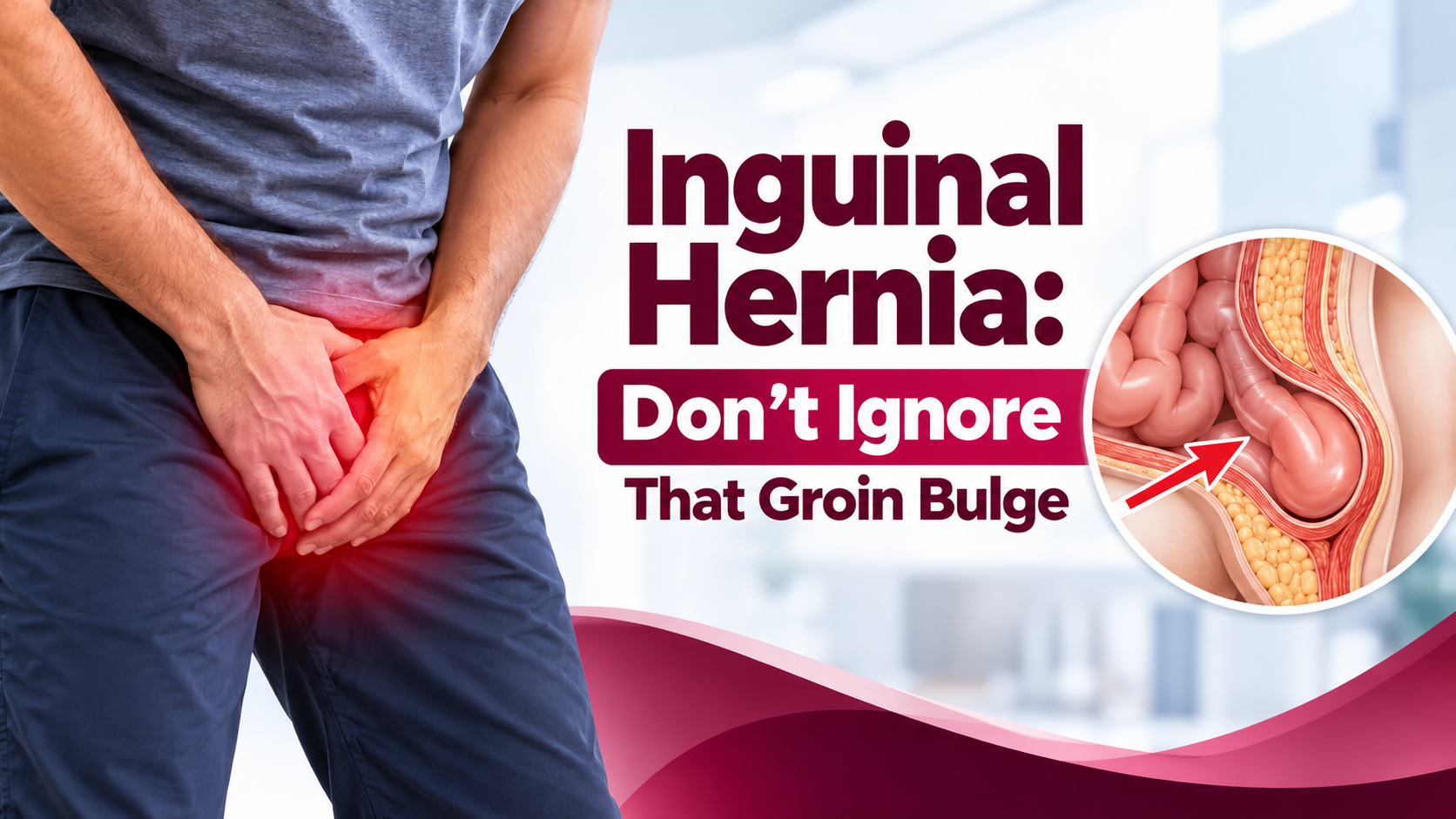
Understanding Inguinal Hernia: Causes, Symptoms, Treatment, and Recovery
An inguinal hernia is one of the most common surgical conditions affecting both men and women. While it may start as a small, painless swelling, delaying treatment can lead to serious complications. Fortunately, modern laparoscopic and robotic techniques offer safe, effective treatment with faster recovery.
What Is an Inguinal Hernia?
An inguinal hernia occurs when a part of the intestine or fatty tissue pushes through a weak area in the muscles of the lower abdominal wall (groin). This creates a visible or palpable bulge in the groin, which may become more noticeable while standing, coughing, or lifting heavy objects.
Inguinal hernias are much more common in men because of the natural weakness in the inguinal canal through which the testicles descend before birth.
How Does an Inguinal Hernia Present?
The most common presentation is a swelling in the groin that may:
- Increase in size while standing or coughing.
- Reduce or disappear on lying down.
- Become more prominent after physical activity or lifting heavy objects.
- Be present on one or both sides.
Some patients notice the swelling only occasionally, while others have a persistent bulge.
What Are the Symptoms?
Symptoms can vary depending on the size of the hernia.
Common symptoms include:
- A groin swelling or bulge.
- Pain or discomfort in the groin, especially during walking, coughing, or lifting.
- A feeling of heaviness or dragging in the groin.
- Burning or aching sensation over the swelling.
- In men, swelling may extend into the scrotum.
Warning Signs (Medical Emergency)
Seek immediate medical attention if you experience:
- Sudden severe groin pain.
- A painful swelling that cannot be pushed back.
- Redness or discolouration over the swelling.
- Vomiting or abdominal distension.
- Inability to pass stools or gas.
These symptoms may indicate a strangulated hernia, where the blood supply to the intestine is compromised. This requires emergency surgery.
How Is It Diagnosed?
Most inguinal hernias are diagnosed through a careful physical examination by a surgeon.
Occasionally, imaging tests such as:
- Ultrasound
- CT scan
- MRI (in selected cases)
may be recommended if the diagnosis is uncertain or for recurrent or complex hernias.
What Is the Treatment?
Unfortunately, an inguinal hernia does not heal with medicines, exercises, or abdominal belts.
The definitive treatment is surgical repair, where the weakness in the abdominal wall is reinforced using a surgical mesh.
Early surgery prevents enlargement of the hernia and reduces the risk of complications.
Modern Surgical Options
Laparoscopic (Keyhole) Hernia Repair
Laparoscopic surgery is performed through three small incisions using a high-definition camera.
Benefits include:
- Smaller scars.
- Less postoperative pain.
- Faster recovery.
- Earlier return to work.
- Excellent cosmetic results.
- Particularly beneficial for bilateral (both sides) and recurrent hernias.
Robotic Hernia Repair
Robotic surgery is an advanced minimally invasive technique that offers the surgeon enhanced precision, three-dimensional visualisation, and greater dexterity.
Potential advantages include:
- Superior precision during complex repairs.
- Excellent visualisation of important structures.
- Reduced tissue trauma.
- Minimal postoperative pain.
- Faster recovery.
- Better ergonomics for complex and recurrent hernias.
Not every patient requires robotic surgery. Your surgeon will recommend the most appropriate approach based on the type of hernia, previous surgeries, and overall health.
Recovery After Surgery
Recovery is generally smooth after minimally invasive surgery.
Most patients can:
- Walk within a few hours after surgery.
- Return home the same day or the next day.
- Resume light daily activities within a few days.
- Return to office work in about one week.
- Resume strenuous exercise and heavy lifting after 4–6 weeks, as advised by the surgeon.
Following postoperative instructions and avoiding heavy lifting during the healing period helps achieve the best long-term results.
When Should You See a Surgeon?
Consult a surgeon if you notice:
- Any swelling in the groin.
- Groin pain during activity.
- A swelling that increases in size.
- Recurrent swelling after previous hernia surgery.
- Sudden pain or an irreducible swelling.
Early evaluation allows planned surgery before complications develop.
A Patient Education Guide By
Dr. Puneeth Thalasta
MS, MCh (Minimal Access Surgery, AIIMS New Delhi)
FSGE (RGUHS) FIAGES, FALS
Consultant – General, GI and Minimal Access Surgery
Prakriya Hospitals, Bangalore