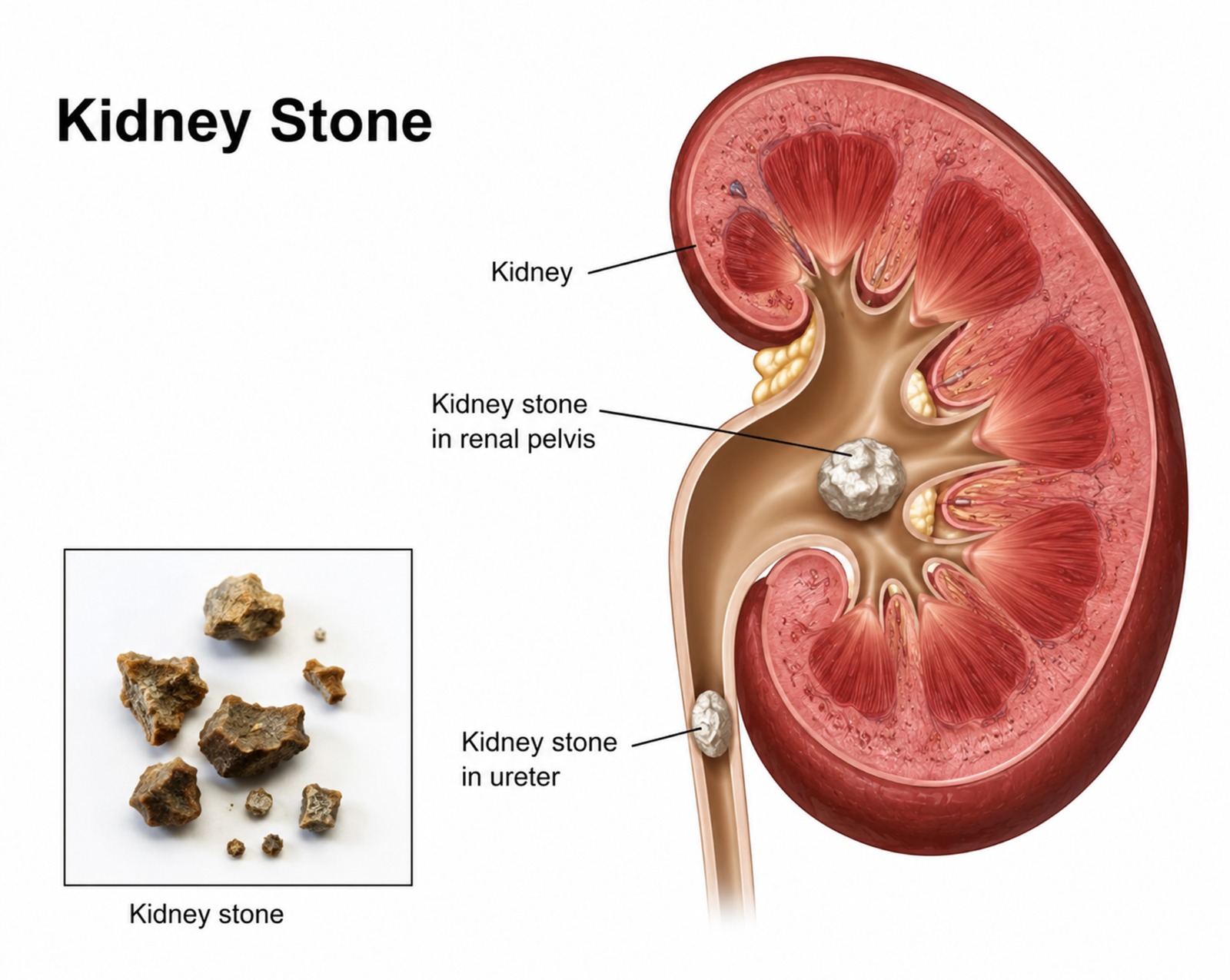
Kidney stones are no joke. If you’ve had one, you know the pain can drop you to your knees. If you haven’t, let’s keep it that way. Here’s what you need to know.
1. What Are Renal Stones?
Kidney stones are hard, crystal-like deposits that form when your urine has too much of certain minerals and salts, and not enough fluid to dilute them. They start tiny like a grain of sand, but can grow to the size of a golf ball.
Main Types:
1. Calcium oxalate – 80% of stones. Forms when calcium combines with oxalate in urine
2. Uric acid – Common in people who eat lots of red meat, have gout, or are dehydrated
3. Struvite – Linked to UTIs. Can grow fast and become “staghorn” stones
4. Cystine – Rare, runs in families due to genetic disorder
2. Why Do You Get Them? The Risk Factors
You don’t need bad luck – just the wrong mix of habits + biology.
Biggest triggers:
– Dehydration: 1 cause. Less water = concentrated urine = crystals stick together
– Diet: Too much salt, animal protein, sugar, oxalate-rich foods like spinach, nuts, chocolate
– Medical conditions: Hyperparathyroidism, gout, obesity, IBD, recurrent UTIs
– Family history: If your dad had stones, your risk doubles
– Medications: Diuretics, calcium antacids, some seizure meds
– Geography: Hot climates = more sweating = higher risk. Welcome to “Stone Belt” states
3. Symptoms: How Do You Know?
Small stones may pass silently. Big ones announce themselves.
Classic signs:
– Severe flank pain – Starts in back/side, radiates to groin. Comes in waves. Often called “worse than childbirth”
– Blood in urine – Pink, red, or brown pee
– Burning urination + urgency – Feels like UTI
– Nausea/vomiting – From kidney pain
– Fever + chills – Danger sign. Means infection + blockage. Go to ER
When it’s an emergency: Fever, unable to pass urine, vomiting so you can’t keep fluids down, or only 1 kidney.
4. Diagnosis: Finding the Stone
1. CT scan – Gold standard. Finds 99% of stones, size, location
2. Ultrasound – No radiation. Good for pregnant women, kids
3. X-ray KUB – Misses 40% of stones but cheap
4. Urine test – Checks for blood, infection, crystal types
5. Blood test – Calcium, uric acid, kidney function
6. Stone analysis – If you pass it, save it. Tells us how to prevent next one
5. Treatment: From “Drink Water” to Surgery
Depends on size + location + symptoms.
For stones <5mm:
– 90% pass on their own in 1-3 weeks
– MET: Medical Expulsive Therapy – Tamsulosin relaxes ureter
– Pain control: NSAIDs like diclofenac work better than opioids
– Hydration: 3-4L water/day. Goal = pee light yellow
For stones 5-10mm: 50/50 chance. Try MET for 4-6 weeks.
For stones >10mm or stuck:
1. ESWL: Shock Wave Lithotripsy – Sound waves break stone. Non-invasive
2. Ureteroscopy: Thin scope + laser through bladder. No cuts. 1-day surgery
3. PCNL: Keyhole surgery through back for large/staghorn stones
4. RIRS: Flexible scope + laser for kidney stones up to 2cm
6. Prevention: Stop the Next One
50% of people get another stone in 5-10 years unless they change habits.
The 5 Rules:
1. Fluids, fluids, fluids: 2.5-3L urine/day. That’s ∼3L water. Check pee color
2. Cut sodium: <2,300mg/day. Salt makes you pee calcium
3. Moderate protein: Too much meat = uric acid stones. Think palm-size portion
4. Get dietary calcium: 1000mg/day from food. Paradox: Low calcium diet = MORE stones. Don’t take supplements unless prescribed
5. Limit oxalate if you’re a former stone maker: Spinach, beets, nuts, tea, chocolate. Pair with calcium foods to bind oxalate
Lemonade hack: Citrate in lemons stops stones. 4oz lemon juice in 2L water daily.
7. Myths vs Facts
Myth: Milk causes stones.
Fact: Dietary calcium actually prevents calcium oxalate stones.
Myth: Cranberry juice helps.
Fact: Can make calcium oxalate stones worse. High in oxalate.
Myth: Beer flushes stones.
Fact: Dehydration from alcohol increases risk. Water flushes stones.
Bottom Line
Kidney stones are common, painful, but preventable. If you’ve had one, get a 24-hour urine test to find your specific risk. Drink enough that you’re peeing clear 10-12 times a day.
See a urologist if: Pain + fever, single kidney, stone >10mm, or 2+ stones in a year.
Had a stone before? What triggered yours? Drop it below – your story might help someone else avoid the ER at 2am.
Disclaimer: This is general info, not medical advice. For diagnosis/treatment, talk to a healthcare professional.
Dr. V. Manjunath
MBBS, MS – General Surgery, MCh – Urology
Consultant – Urology and Andrology