Every year, like clockwork, Bengaluru prepares for the monsoon. But while the rains bring relief from the heat, they also usher in our city’s most predictable tragedy: The Dengue Surge.
As a responsible clinician and a resident of this city, I am writing this because we are standing on the precipice of the May–July window. If we do not understand the disease today, we will be mourning its victims tomorrow.
The Magnitude: Why 2026 “May Be” a Critical Year
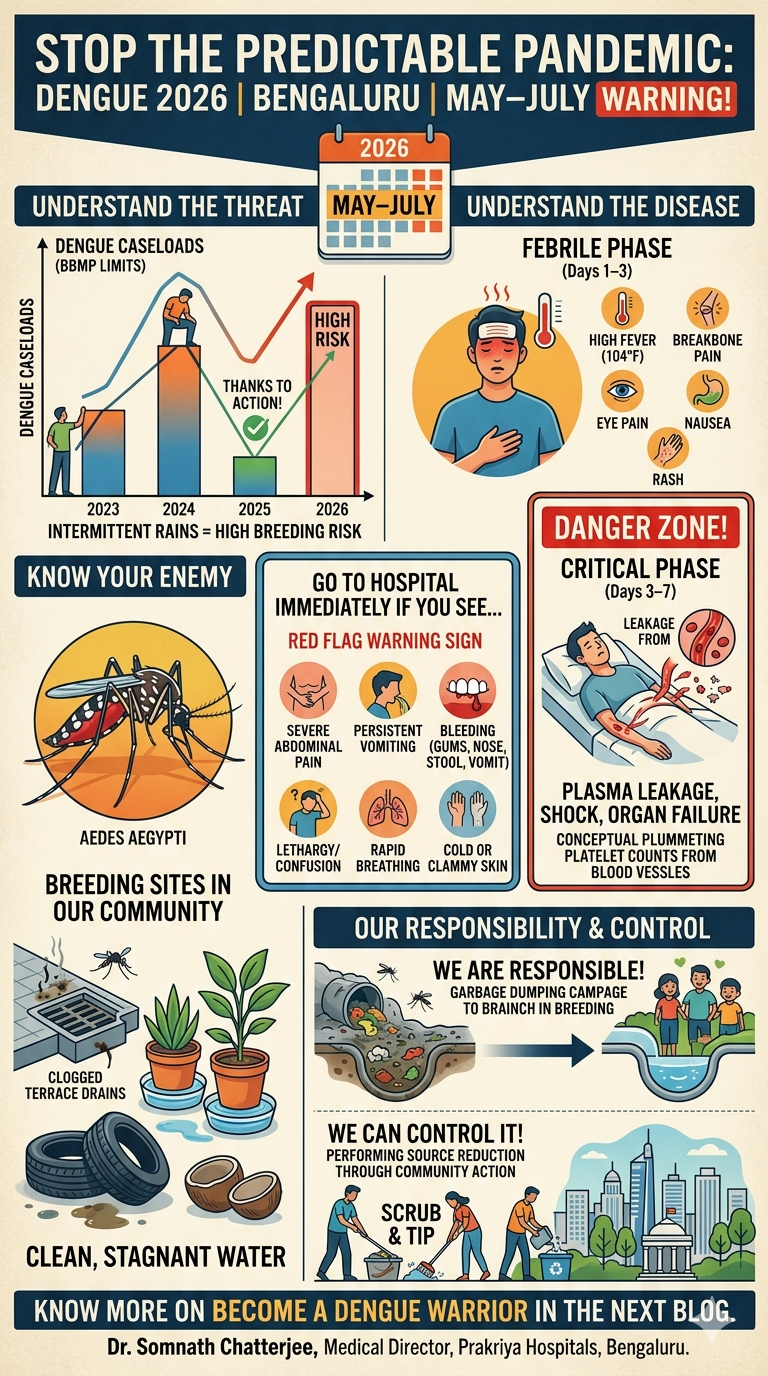
Dengue is not just a “fever season”; it is an annual economic and health drain. To understand the scale, we must look at where we have been.
| Year | Confirmed Cases (BBMP) | The Reality |
| 2022 | 2,335 | Moderate incidence. |
| 2023 | 11,136 | A massive 377% spike that caught us off guard. |
| 2024 | 15,282+ | The peak crisis. Hospitals were overwhelmed; ICUs were full. |
| 2025 | 3,428 | A “success” year due to heavy flushing rains and strict legal fines. |
The Forecast for 2026: Because 2025 was a “low” year, the city’s collective immunity may be lower, and complacency is likely to be high. If we see intermittent rains – which create small, stagnant pools rather than flushing them away – we are looking at a 2026 pandemic that could rival the 2024 crisis.
What is Dengue? (Know Your Enemy)
Dengue is a viral infection caused by four distinct virus serotypes (DENV 1-4). It is transmitted to humans through the bite of an infected Aedes aegypti mosquito.
The “Urban” Mosquito
Unlike the mosquitoes that breed in dirty swamps, the Aedes mosquito is a “sophisticated” urbanite. It breeds in clean, stagnant water – the kind found in your terrace drains, flower pot saucers, refrigerator drip trays, and discarded coconut shells. In Bengaluru, the public storm water drains are also potential breeding grounds for the mosquito.
It bites primarily during the day, making schools, offices, and homes the primary transmission zones.
The Disease Progression: From Mild to Life-Threatening
Understanding how Dengue presents is the difference between a recovery at home and a tragic outcome.
1. The “Febrile Phase” (Days 1–3)
This usually begins with a sudden, high fever (often reaching $104^{\circ}F$). It is accompanied by:
- Severe “break bone” pain (joint and muscle aches).
- Intense pain behind the eyes.
- Nausea and vomiting.
- A faint skin rash.
2. The “Critical Phase” (The Danger Zone: Days 3–7)
This is the most misunderstood part of the disease. As the fever starts to drop (usually below 100∞F), families often think the patient is getting better. In reality, this is when Dengue becomes deadly.
In severe cases, the virus causes the blood vessels to become “leaky.” The liquid part of your blood (plasma) leaks into the chest and abdomen. This leads to:
- Dengue Hemorrhagic Fever (DHF): Internal bleeding and plummeting platelet counts.
- Dengue Shock Syndrome (DSS): Blood pressure drops so low that organs fail. This is why patients end up in the ICU, and this is why they die.
Red Flags: When to Seek Immediate Hospitalization
Most Dengue can be managed with hydration and rest. However, if you see any of these Warning Signs, do not wait for a blood report. Go to the Hospital immediately:
- Severe abdominal pain or tenderness.
- Persistent vomiting (unable to keep fluids down).
- Bleeding from the gums or nose, or blood in stools.
- Tiredness, confusion, or extreme restlessness.
- Rapid breathing or difficulty breathing.
- Cold or clammy skin.
The Human and Economic Cost
When we talk about a “pandemic,” we aren’t just talking about numbers. We are talking about:
- Family Trauma: The sight of a child in an ICU struggling for breath.
- Financial Ruin: The cost of ICU care in private hospitals can wipe out a middle-class family’s savings in days.
- Community Paralysis: When 15,000 people are sick, the city’s productivity halts, and our healthcare infrastructure reaches a breaking point.
Why Does This Keep Happening?
It is a hard truth to swallow, but this pandemic is fueled by a lack of civic sense. * It is caused by the garbage we throw that blocks the drains.
- It is caused by the stagnant water we allow to sit on our terraces.
- It is caused by the “It will not affect my family this year” belief.
- It is caused by the “I am not responsible for the problem” attitude.
But it is our problem. The mosquito breeding in your neighbor’s discarded tyre doesn’t care whose house it enters next.
“What Next”?
Awareness is the first step, but it is useless without action. In my next post, I will lay out a Call to Action – a hybrid model of how we, as communities, can organize ourselves ward-by-ward to ensure 2026 is the year we finally stop the cycle of death and debt.
The rains are coming. It’s time to wake up.
Expert Tip: If you or a family member has a fever, avoid Aspirin or Ibuprofen (NSAIDs), as these can worsen the bleeding risk in Dengue. Use only Paracetamol and focus on aggressive hydration (ORS, coconut water, juices).
Dr. Somnath Chatterjee MD (Anaes), FRCA, EDIC, FFICM
Medical Director
Prakriya Hospitals, Bengaluru