Eat healthy ….Journey of good health starts with initiation of few steps daily..Take one today…

- Obesity is a global health crisis with profound implications for cancer risk, particularly within the gastrointestinal (GI) tract.
- Excess adiposity contributes to the initiation, progression, and poor outcomes of GI malignancies through a constellation of interrelated mechanisms.
- Obesity is a well-established risk factor for a variety of chronic conditions, including cardiovascular disease, type 2 diabetes, and several forms of cancer .
- Metabolic dysfunction associated with obesity, including chronic low-grade inflammation, oxidative stress, and altered adipokine levels, is increasingly recognized as a key driver in the pathogenesis of gastrointestinal cancers.
- Hence, understanding the link between obesity and gastrointestinal malignancies is critical for developing effective strategies to reduce cancer risk and improve patient outcomes.
- Weight loss, achieved through lifestyle modifications, pharmacotherapy, or procedural interventions (e.g., surgical or endoscopic), has been shown to positively impact metabolic parameters and reduce the risk of cancer.
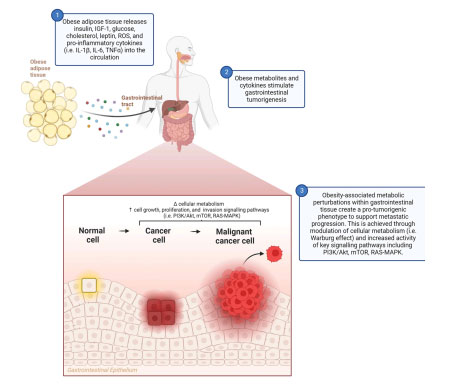
MECHANISM IN BRIEF :
| GASTROINTESTINAL CANCER | MECHANISMS LINKING OBESITY TO CANCER |
| Esophageal Adenocarcinoma | GERD and Barrett’s esophagus progression; VATinduced cytokine inflammation; altered adipokines (↑ leptin, ↓ adiponectin) |
| Gastric Cancer (Cardia) | GERD-induced mucosal damage; elevated intraabdominal pressure; insulin resistance; ↑ leptin and inflammation |
| Colorectal Cancer | Insulin resistance, adipokine imbalance, chronic inflammation; dietary effects on microbiota; metabolic syndrome |
| Hepatocellular Carcinoma | Lipid accumulation → MASLD/MASH → fibrosis and cirrhosis; inflammatory cytokine infiltration |
| Pancreatic Cancer | Free fatty acid infiltration; insulin resistance and hyperinsulinemia; gut microbiome-mediated inflammation |
| Gallbladder Cancer | Gallstone formation from cholesterol supersaturation; delayed gallbladder emptying; hormonal changes (↑ estrogen) |
In conclusion, obesity is a multifaceted risk factor that contributes to the development and progression of gastrointestinal cancers through a complex interplay of inflammatory, metabolic, hormonal, and microbial mechanisms.
Dr. Mounika Reddy C
MBBS, MD (Radiation Oncology), DM (Medical Oncology)
Consultant – Medical Oncologist