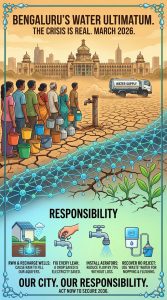
Where Water Flows, Equality Grows—But What Happens When the Taps Run Dry?
March 21, 2026 — Tomorrow is World Water Day. The global theme is “Water and Gender: Where Water flows, Equality grows.” It is a beautiful sentiment, yet as I drive through the parched arteries of Bengaluru, the irony is stifling.
In our city, water doesn’t just flow; it is hunted. It is pumped from 100 kilometers away, pushed 500 meters uphill at a staggering energy cost, or sucked from the dying gasps of the earth through borewells that now reach a terrifying 1,500 feet.
The Sarjapur Road Mirror: A Story of Myopia
At 6:30 AM yesterday, while driving down Sarjapur Road, I witnessed a scene that perfectly encapsulates our crisis. Outside a palatial home, a worker was casually using a high-pressure hose to wash the footpath.
Crystal-clear water – water that had been pumped, treated, and transported at immense public expense – was being used to chase dust off concrete.
This is the face of irresponsible growth. This resident might have the money to pay the bill, and they might be the last to feel the pinch when the tankers stop coming, but they are not immune to the collapse of the ecosystem. When a city runs out of water, the “wealthy” blocks are just the last ones to turn into dust. This myopic “I can afford it, so I can waste it” attitude is the poison in our groundwater.
A 50-Year Vicious Cycle
In the last five decades, Bengaluru has transformed from a city of 1.9 million to a hyper-congested megalopolis of nearly 15 million. Our limits have exploded from 150 sq. km to over 700 sq. km.
| Metric | ~1976 (50 Years Ago) | 2026 (Today) | Growth Factor |
| Population | ~1.9 Million | ~14.8 Million | ~8x |
| City Area | ~150 sq. km | ~741 sq. km (BBMP) | ~5x |
| Registered Vehicles | ~1.2 Lakh | ~1.25 Crore (12.5M) | ~100x |
| Water Demand | ~400 MLD | ~2,600+ MLD | ~6.5x |
| Lakes (Live/Healthy) | 280 | < 80 (mostly polluted) | -70% Loss |
We are caught in a positive vicious cycle—and not the good kind:
- Uncontrolled Growth: Population booms without infrastructure.
- Deep Extraction: Groundwater vanishes, making the earth “hard” and lakes like Hebbal and Nagavara dry up.
- The Transport Tax: We ferry water in thousands of diesel tankers, causing massive traffic congestion and pumping tons of CO2 into the air.
- The Energy Drain: Pumping water uphill is Bengaluru’s biggest electricity consumer.
- The Quality Tax: Our water is now so hard that we use RO plants that waste 3 liters for every 1 liter we drink.
The Lifeline: Where does the water come from?
Bengaluru has a unique geography—it sits on a ridge at an altitude of 900 meters. This is its greatest challenge: every drop of river water must be pumped uphill, which is incredibly expensive and energy-intensive.
- The Cauvery Connection: The city’s primary potable source is the Cauvery River, located nearly 100 km away.
- Cauvery Stage V: This is the latest “mega-project” (fully commissioned in late 2024/2025). It added 775 MLD specifically to serve the 110 villages added to the city limits in 2008 (like Mahadevapura and Bellandur).
- Annual Allotment: Bengaluru is currently allocated 24 TMC (Thousand Million Cubic feet) of Cauvery water annually.
- The “Unserved” Majority: Despite Stage V, vast parts of the city (Peripheral areas and high-rises) still have zero pipe connectivity. They rely 100% on groundwater (borewells) and private tankers.
The “Low Rainfall” Nightmare
If the monsoon fails (as it did partially in 2024), Bengaluru has no “Plan B” reservoir.
- KRS Dam Depletion: When the Krishna Raja Sagara dam levels drop, the drinking water share for Bengaluru is prioritized, but the pressure in pipes falls, and “tail-end” areas get nothing.
- Groundwater Collapse: Without rain to recharge the earth, borewells (already reaching depths of 1,500+ feet) go bone-dry.
- The Result: The city enters a “Water Emergency” where tankers become the only source of survival, and prices skyrocket.
Financial Impact on the Family
The cost of water is no longer a “utility bill”; it is becoming a significant portion of the household budget.
- Average BWSSB Bill: A family of four with a pipe connection pays roughly ₹600–₹1,000/month.
- Tanker Reliance: In water-scarce areas (East/South Bengaluru), a family often needs 3–4 tankers a month (5,000L each).
- The Scarcity Spike: In normal times, a tanker costs ₹800–₹1,000. During scarcity, this has been seen to jump to ₹2,500–₹4,000.
- Total Monthly Spend: A family in a “dry” ward can easily spend ₹12,000 to ₹25,000 per month just to keep the taps running.
“Waterworld” or Cooperation?
The movie Waterworld starring Kevin Costner depicts a global conflict over “Dryland.” In South India, the Karnataka-Tamil Nadu dispute is often cited as a precursor to “Water Wars.”
- Will it get worse? Yes, if we rely solely on extracting water from the river. As Bengaluru’s demand grows, it takes away from the irrigation needs of farmers in both states, leading to political and social friction.
- The Gender Impact: Per the 2026 theme, this conflict hits women hardest. In rural areas, they walk further for water; in urban areas, they manage the “stress” of a dry household.
- The Hope: The solution isn’t fighting for more river water (which is a finite resource); it is Circular Management. If Bengaluru starts recycling 80% of its sewage and catching 50% of its rain, it reduces its “theft” from the river, easing the interstate tension.
Prevention is Better than Cure: The Strategy for 2036
If we do not want 2036 to be the year of “Water Wars,” we must move from “complaining” to “anticipating.”
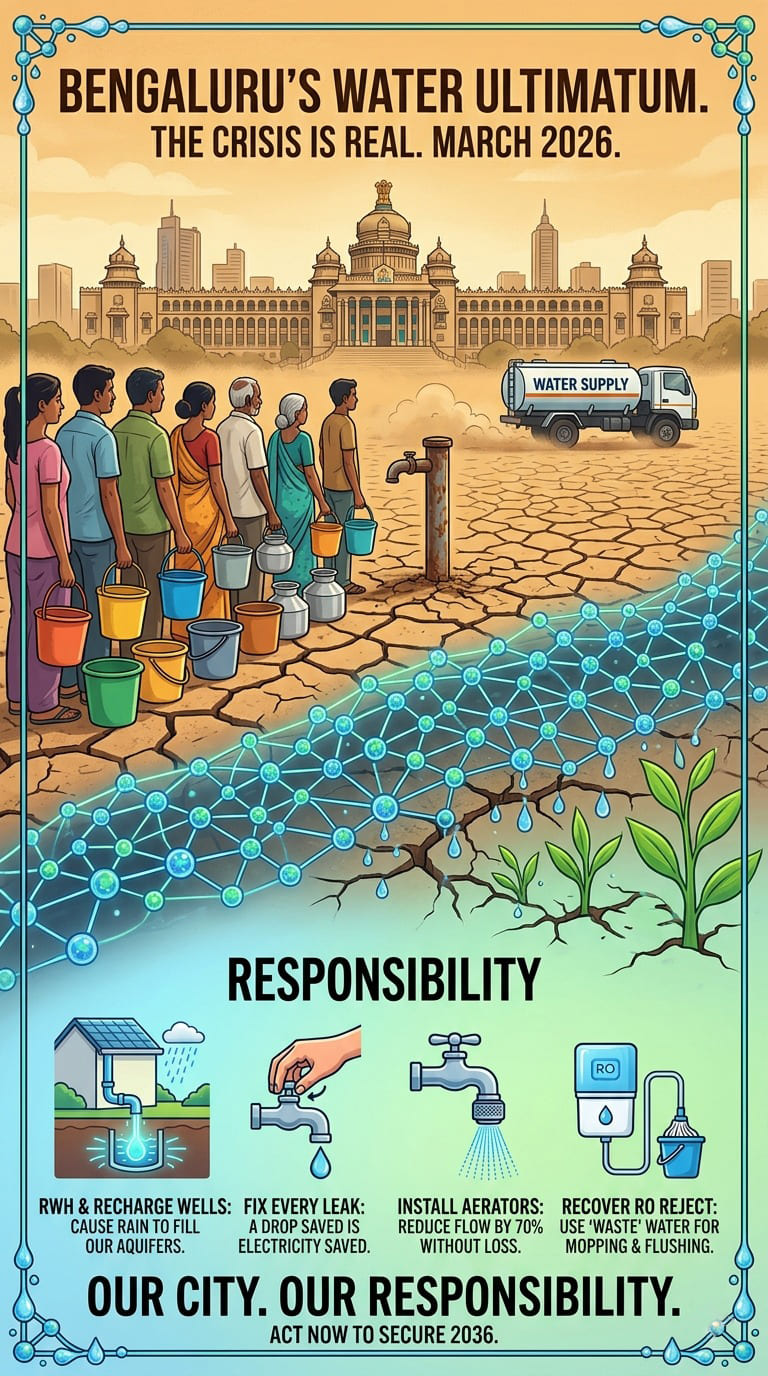
- The Pressure Revolution: We must mandate pressure reduction in every tap. One of the core criteria for green buildings is reducing pipe pressure. By simply installing aerators, we can reduce water flow by 70% without losing the “feel” of pressure. This should be a law, not a choice.
- The “Tanker Drill”: We need a civic reality check. I propose a 72-hour Mock Drill where all private tankers are taken off the roads. Let us see how our high-rises and tech parks hold up. This “controlled crisis” will do more for education than a thousand posters. It will force us to realize that without the “Tanker Mafia,” many of us are only three days away from total thirst.
- Targeted Consumption & Punishment: Water wastage should be a punishable offense. We need individual smart meters in every flat. If you exceed a sustainable quota, the price should not just double—it should hurt.
- Education at the Source: We must take this to the schools, the colleges, and the corporate boardrooms. Our children need to know that the “Garden City” they are inheriting is actually a “Concrete Sieve.”
The BWSSB’s Circular Water Economy – Strategy for the next decade
As of March 2026, Bengaluru’s strategy has shifted from just “storing” water to a massive “Circular Water Economy” model. The BWSSB (Bangalore Water Supply and Sewerage Board) is currently executing a multi-pronged plan to ensure that no drop of rain or treated sewage is wasted.
1. The “Lake-Linked” Rainwater Strategy: The biggest shift in 2026 is that the BWSSB is no longer asking apartments to just store rainwater in their own sumps. Instead, they are facilitating direct lake-linking.
- Surplus Diversion: Large tech parks and apartment complexes often have more rooftop area than storage capacity. During heavy rains, their sumps overflow. BWSSB has identified 74 lakes (with 17 pilot projects including Sowl Kere, Hoodi Lake, and Sheelavantha Kere) to receive this “clean” excess rainwater directly via dedicated pipelines.
- Groundwater Boost: By feeding this filtered rainwater into “recharge zones” within these lakes, the surrounding groundwater table (borewells within a 2 – 3km radius) sees a measurable rise in water levels.
2. The “Million Wells” Movement (Recharge Wells): The city is currently pushing toward the goal of 1 million recharge wells.
- The 2:1 Mandate: As of 2025-26, the BWSSB has strictly mandated that for every one new borewell drilled, two recharge wells must be constructed.
- Traditional Knowledge: The campaign utilizes the expertise of the Bhovi community (traditional well-diggers) to dig shallow recharge wells (20–30 feet deep). These wells “inject” rainwater back into the shallow aquifer, which acts like a natural underground sponge.
3. Filling Lakes with Treated Water (STP Strategy): By June 2026, Bengaluru will have 26 new Sewage Treatment Plants (STPs) fully operational, bringing the city’s treated water capacity to 2,200 MLD (Million Liters per Day).
- Indirect Potable Reuse: Rather than letting treated water flow away to other districts, BWSSB is pumping it into city lakes. The lakes act as a natural filter, and as the water seeps into the ground, it recharges the borewells that thousands of citizens rely on.
- The 80% Rule: BWSSB’s current goal is to tap 80% of all treated wastewater specifically for lake rejuvenation.
4. Enforcement and the “Green Star” Rating: The BWSSB has moved from “appeals” to “incentives and penalties”:
- Green Star Rating: Apartments and hotels are now rated (1 to 5 stars) based on how much rainwater they recharge and how much treated water they reuse. High-rated buildings get public recognition and prioritized service.
- Smart Penalties: RWH (Rainwater Harvesting) is mandatory for buildings on 1,200 sq. ft (new) or 2,400 sq. ft (old) plots. Since late 2025, the enforcement has been automated—properties without functional RWH systems see a 50% to 100% penalty automatically added to their monthly water bills.
5. Sanchari Cauvery (The Mobile Lifeline)
For the 110 villages and “dry” peripheral zones (like Varthur and Whitefield), the BWSSB launched Sanchari Cauvery in August 2025.
- As of March 2026, they have expanded the fleet to over 120 government-regulated tankers.
- These tankers deliver water at fixed, non-exploitative prices to areas where the groundwater recharge has not yet caught up with demand, breaking the “tanker mafia” cycle.
The Final Word
Our City: Our Responsibility
Bengaluru is growing by leaps and bounds, but our wisdom is lagging behind. We are currently living on “borrowed water” and “borrowed time.”
Prevention is better than cure. We can fix our taps today, or we can fight for a bucket of muddy water tomorrow. The choice is ours, but the clock is ticking. By the time the next decade rolls around, where the water flows – or fails to flow – will determine whether our city grows or withers away.
Dr. Somnath Chatterjee
Medical Director, Prakriya Hospitals
Bengaluru