
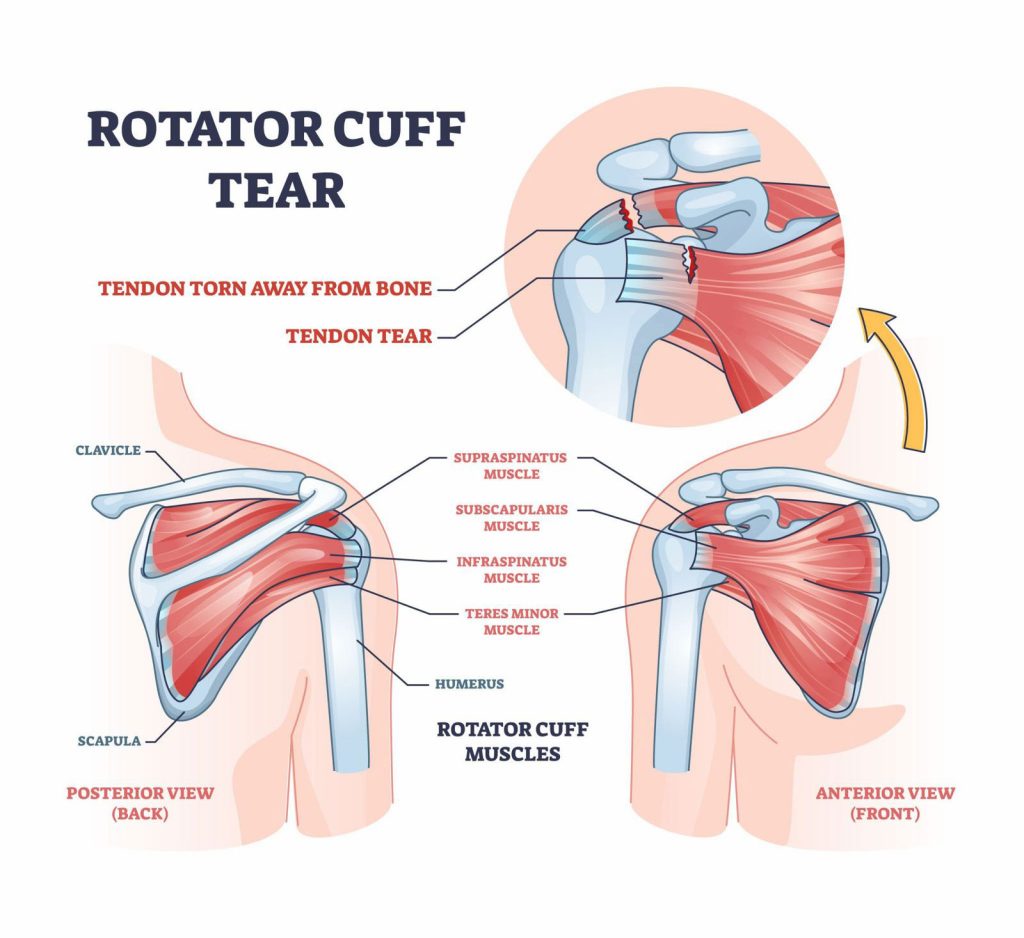
Your shoulder is an amazing joint. It lets you throw a ball, reach for the top shelf, wave to a friend, and swim. But to do all that lifting and moving, your shoulder relies on a team of four small muscles and their ropes (called tendons). Together, they form the rotator cuff.
When these tendons get stretched, frayed, or torn, it’s called a rotator cuff tear. It is one of the most common reasons for severe shoulder pain.
Why Do Rotator Cuff Tears Happen?
Tears generally happen in one of two ways:
● Wear and Tear (Over Time): As we get older, our tendons naturally get a bit weaker and don’t heal as easily. If you do a lot of repetitive overhead movements—like playing badminton or tennis, painting, or lifting—the tendon can slowly fray over time.
● Sudden Injuries (Trauma): This happens instantly. Falling on an outstretched hand, catching yourself during a slip, or jerking a heavy object can tear even a perfectly healthy tendon right away.
The Warning Signs: What Does It Feel Like?
If you have a rotator cuff tear, you will likely experience:
- A dull, deep ache deep inside your shoulder.
- Trouble sleeping, especially if you roll over onto that arm.
- Weakness when you try to lift your arm or brush your hair.
- A catching, clicking, or snapping feeling when you move your shoulder.
How Are They Treated?
Not every tear requires a trip to the operating room! The right treatment depends on how big the tear is, how much it hurts, and how it happened.
1. Non-Surgical Treatment
For small, partial tears that happened slowly over time, we usually start with simpler steps. This includes rest, avoiding activities that hurt, taking mild pain relievers, or sometimes getting a targeted injection to calm down severe inflammation.
2. The Power of Physiotherapy
Physiotherapy is incredibly important. While exercises can’t physically “glue” a torn tendon back together, a physiotherapist can help you strengthen the other healthy muscles around the joint.
These stronger muscles take over the workload, restoring your movement and wiping out the pain.
When Is Surgery Needed?
Surgery becomes the best option if:
- Your shoulder still hurts after 6 months of physiotherapy and rest.
- The tear is very large, leaving your arm feeling incredibly weak.
- You need total shoulder strength for your job or favorite sport.
A Crucial Warning: Never Ignore a Sudden Injury
If you tore your shoulder during a sudden accident, fall, or trauma, do not wait to see a doctor. When a tendon is torn violently, it acts like a snapped rubber band—it begins to pull away from the bone (retraction). If left alone for too long, the unused muscle can actually turn into fat. Once that happens, it is very difficult or even impossible to fix. Early checking prevents this permanent damage.
Modern, Gentle Fixes: Keyhole Surgery (Arthroscopy)
If you do need surgery, the good news is that you don’t have to face a massive, painful scar. Today, we use advanced shoulder arthroscopy, commonly known as keyhole surgery. Instead of cutting open the shoulder, a specialist makes 2 or 3 tiny pinhole openings (less than a centimeter each). A miniature camera and tiny instruments are guided inside to look at the joint on a high-definition screen. The torn tendon is then gently and securely stitched back to the bone using microscopic anchors.
- The Benefits: Tiny scars, significantly less pain after surgery, no damage to surrounding muscles, and you can usually go home the very same day!
The Golden Rule: Surgery is Only Half the Battle
It is vital to know that a successful surgery is only 50% of the puzzle. The other 50% is your physiotherapy afterward.
A repaired tendon takes time to firmly heal back to the bone. Your recovery will go through three simple phases:
- Protect (Weeks 1-4): You will wear a sling to let the tendon rest and heal safely.
- Move (Weeks 5-8): You will start gentle movements, often using your other arm to help, so your shoulder doesn’t get stiff or frozen.
- Strengthen (Weeks 9+): You will start light resistance exercises to rebuild your muscle power so you can return to normal life.
Skipping your post-surgery physiotherapy can cause the shoulder to become stiff or cause the repair to fail.
The Bottom Line
Shoulder pain that wakes you up at night or keeps you from lifting your hand isn’t something you
just have to live with. A quick check-up and an MRI can tell us exactly what’s wrong. Whether the answer is a dedicated exercise plan or a quick keyhole fix, you can get your active, pain-free life back.
Dr. Akash Kalaskar
MBBS, MS, MRCS (Edinburgh), MCh (Liverpool)
Consultant – Orthopaedic Surgeon | Specialist in Knee & Shoulder Arthroscopy