Booming Economy, Struggling Livability
During a conversation with a friend (both of us had spent significant part of our life outside India), I asked him if the quality of life in India would change in our lifetime. Without a pause or hesitation, his monosyllabic answer was and emphatic “No”. This got me thinking. This blog about the quality of life in India, the invisible ceiling on our potential, and the missing ingredient required to break through it: Discipline.
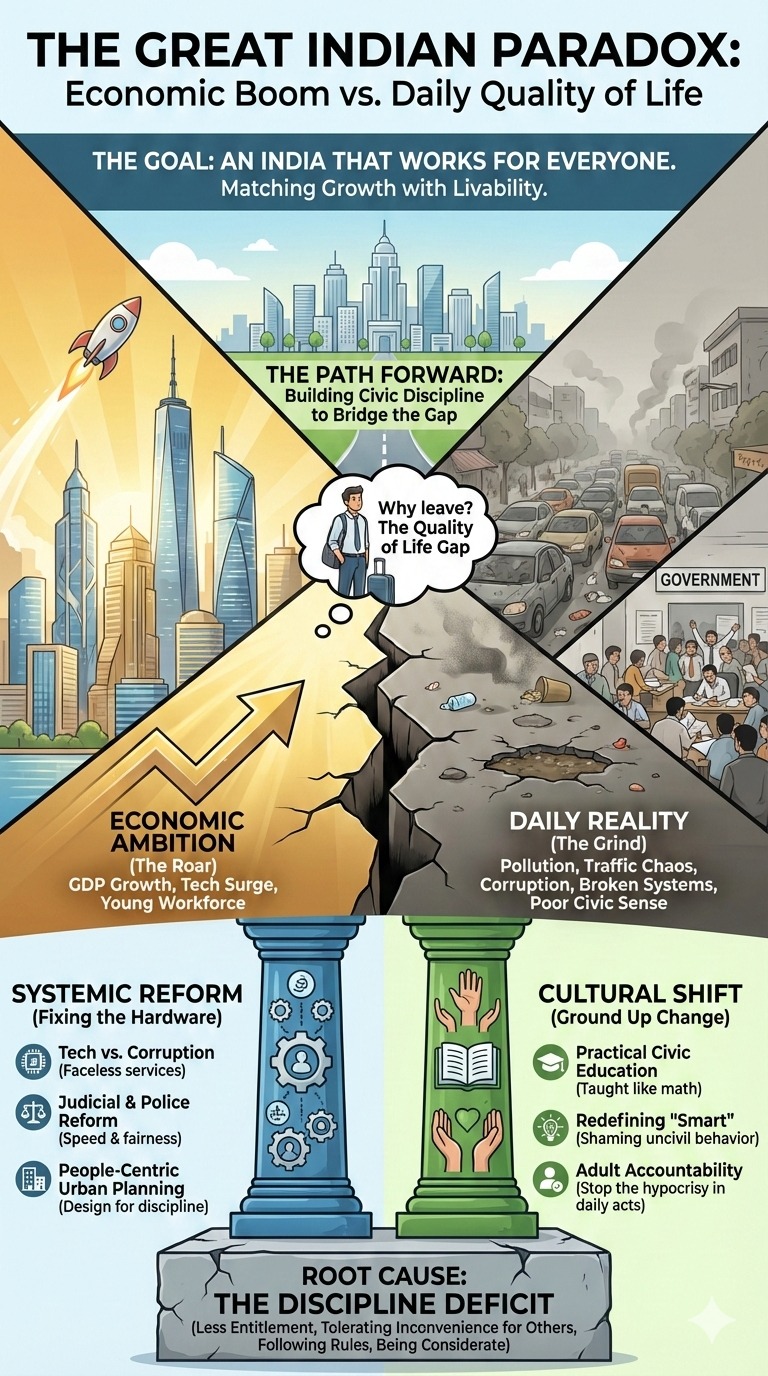
India is the story everyone wants to be a part of right now. One of the world’s fastest-growing major economies, a massive demographic dividend of an ambitious young population, and a technological surge that is envied globally. We are told that this is India’s decade.
Yet, beneath these macroeconomic cheers lies a quieter, uncomfortable reality. A significant portion of our bright minds – the educated, upwardly mobile next generation destined to lead this boom, are actively looking for an exit. They want to settle outside India. Why? Why leave a party that is just getting started?
The Reality Check (Impact Statistics 2025–2026):
The “Invisible Tax” we pay for our lack of collective discipline.
The desire to emigrate isn’t born from a lack of patriotism. It’s born from exhaustion. In India, daily life often feels like an obstacle course. The answer doesn’t lie in GDP tables; it lies in the daily grind.
| The Problem | The Impact (As of 2026) |
| The Brain Drain | Over 12.6 lakh students left India for studies in 2025. In 2024 alone, over 2.06 lakh Indians renounced their citizenship. |
| The Corruption Tax | India ranks 96st out of 180 coutnries in the Corruption Perception Index. A shocking 39% of public service users in India reported paying a bribe in the last 12 months just to get basic work done. |
| Justice Delayed | Over 5.4 crore (54 million) cases are pending in Indian courts. Nearly 1.8 lakh cases have been pending for over 30 years. This is why people take the law into their own hands. |
| The “Jaldi” Tax | In cities like Bengaluru and Pune, commuters lose up to 168 hours (7 full days) per year stuck in traffic. Average speeds in major hubs have dropped to a crawl of 16 kmph. |
| The Life Tax | Air pollution is cutting 3.5 years off the average Indian’s life. In Delhi-NCR, that number jumps to a staggering 8.2 years of life lost compared to WHO standards. |
| The Water Crisis | Only 55-60% of Indians have access to “safely managed” drinking water. Over 340 million people still lack a reliable, safe water source at home. |
| The Problem | The Impact (As of 2026) |
| The Brain Drain | Over 12.6 lakh students left India for studies in 2025. In 2024 alone, over 2.06 lakh Indians renounced their citizenship. |
| The Corruption Tax | India ranks 96th out of 180 coutnries in the Corruption Perception Index. A shocking 39% of public service users in India reported paying a bribe in the last 12 months just to get basic work done. |
| Justice Delayed | Over 5.4 crore (54 million) cases are pending in Indian courts. Nearly 1.8 lakh cases have been pending for over 30 years. This is why people take the law into their own hands. |
| The “Jaldi” Tax | In cities like Bengaluru and Pune, commuters lose up to 168 hours (7 full days) per year stuck in traffic. Average speeds in major hubs have dropped to a crawl of 16 kmph. |
| The Life Tax | Air pollution is cutting 3.5 years off the average Indian’s life. In Delhi-NCR, that number jumps to a staggering 8.2 years of life lost compared to WHO standards. |
| The Water Crisis | Only 55-60% of Indians have access to “safely managed” drinking water. Over 340 million people still lack a reliable, safe water source at home. |
The disconnect between our soaring economic ambition and our on-the-ground reality is vast. While our nation builds rockets to reach the moon, our citizens struggle to cross the street safely on earth.
We tolerate things that would cause national outrage in many developed nations. We normalize breathing toxic air during winter. We accept that a 10-kilometer commute might take 90 minutes. We accept potholes as permanent geological features of our roads. We accept that interacting with government machinery might require a “speed money” bribe just to access our basic rights. We have become masters of adjusting, but in doing so, we have stopped demanding or expecting better.
The Root Cause: The Discipline Deficit
We can blame the government, the population density, or history. But if we peel back the layers of traffic chaos, litter, corruption, and broken rules, we find a singular, uncomfortable root cause: a profound lack of national discipline. In India, discipline is often mistaken for obedience to authority. Real discipline is internal. It is civic morality.
What does a disciplined society look like in practice?
- It is less entitlement. Just because you own a big car doesn’t mean you own the road.
- It is tolerating little inconveniences to make life convenient for others. (e.g., Waiting at a red light at 11 PM even when no one is watching).
- It is being in less haste. The constant rush leads to cutting corners, both on the road and in ethics.
- It is giving way, recognizing that someone else might need priority.
Our lack of civic discipline fuels corruption. When we want to bypass a queue or avoid a penalty for breaking a rule, we offer a bribe. The corrupt official and the undisciplined citizen are partners in the same crime that degrades our quality of life.
The roadmap to Change
We cannot build a first-world economy on third-world civic infrastructure. Improving quality of life requires a two-pronged attack: systemic reform and a cultural shift.
1. Systemic Reform: Fixing the Hardware – We must demand more from our institutions.
- Technology against Corruption: The best way to stop bribery is to remove human discretion. All government services licenses, registrations, passports must become faceless, digital, and transparent with tracked timelines. If a file doesn’t move in X days, an automatic escalation should trigger.
- Police and Judicial Reform: Laws mean nothing without enforcement. We need massive investment in judicial infrastructure to speed up trials. Police need to be untethered from political influence and trained in modern, community policing rather than colonial-era crowd control.
- Urban Planning for People, Not Cars: We need to design cities that force good behavior. Wide, usable footpaths prevent people from walking on roads. Proper waste management systems make it easier not to litter.
2. The Cultural Shift: Installing Discipline from the Ground Up
The real solution, however, lies in changing our mindset from “Might is Right” to “Give Way.” We are always in such a desperate hurry, pushing and shoving just to get two minutes ahead. We need to learn to slow down and be considerate. Real discipline means tolerating a small inconvenience to make life easier for someone else. It means respecting the rights of others—like a pedestrian’s right to cross or a neighbour’s right to peace and remembering that for every right we claim, we have a responsibility to fulfill.
This change must start in our schools and, more importantly, in our homes. Discipline should be taught in schools with the same seriousness as Mathematics or Science. Children need to be graded on their civic sense, their ability to queue, and their respect for public property. But teachers can only do so much if the home environment is different. Parents must realize they are the primary “discipline officers” for their children. If a child sees their father bribing a policeman or their mother throwing trash on the road, that child will grow up thinking rules are meant to be broken. Parents must lead by example — by being the first to stop at a red light, the first to give way in traffic, and the first to say “after you”.
The Civic Duty Scorecard
Are we part of the problem or the solution? Take this self-test. For every “Always” give yourself 10 points, for “Sometimes” 5 points, and for “Never” 0 points.
| Metric | The Discipline Question | Score |
| Patience | Do I wait for my turn in a queue without trying to “slip in” or use a contact? | |
| Giving Way | Do I actively slow down to let a pedestrian or another car merge in traffic? | |
| Integrity | Have I refused to pay a bribe (even a small one) in the last 2 years? | |
| Hygiene | Do I carry my trash in my pocket/bag until I find a dustbin? | |
| Responsibility | Do I stop at a red light at night even when no camera or cop is watching? | |
| Modeling | Do I explain to my children why we are following a rule, even if it delays us? | |
| Consideration | Do I keep my noise levels (music/honking) low to respect my neighbors’ peace? | |
| Total Score | Out of 70 |
The Result:
- 60-70 (Nation Builder): You are the India our children want to live in.
- 40-59 (Work in Progress): You mean well, but the “Jaldi” habit is still winning.
- Below 40 (Part of the Paradox): You are enjoying the GDP growth but contributing to the quality-of-life decay.
Conclusion:
Our parents’ generation fought for India’s Independence. Our generation must fight for India’s Civility. We often wait for a “Leader” to fix the roads or end corruption. But the roads are chaotic because we don’t stay in lanes. Corruption exists because we are in too much of a hurry to follow the process. The “Wheel of Change” is a heavy stone. It won’t move because of one government policy; it moves when 1.4 billion people give it a small push in the same direction.
India’s potential is limitless. Our economic engine is roaring. But an economy is meant to serve the people, not the other way around. If our growth doesn’t translate into cleaner air, safer streets, faster justice, and a generally less stressful daily existence, the numbers on a spreadsheet are meaningless.
The next time you are behind the wheel and see someone trying to merge, don’t speed up. Slow down. Smile. Give way. You aren’t just letting a car pass; you are practicing the discipline that will eventually make India a developed nation.
Jai Hind
Dr. Somnath Chatterjee
Medical Director