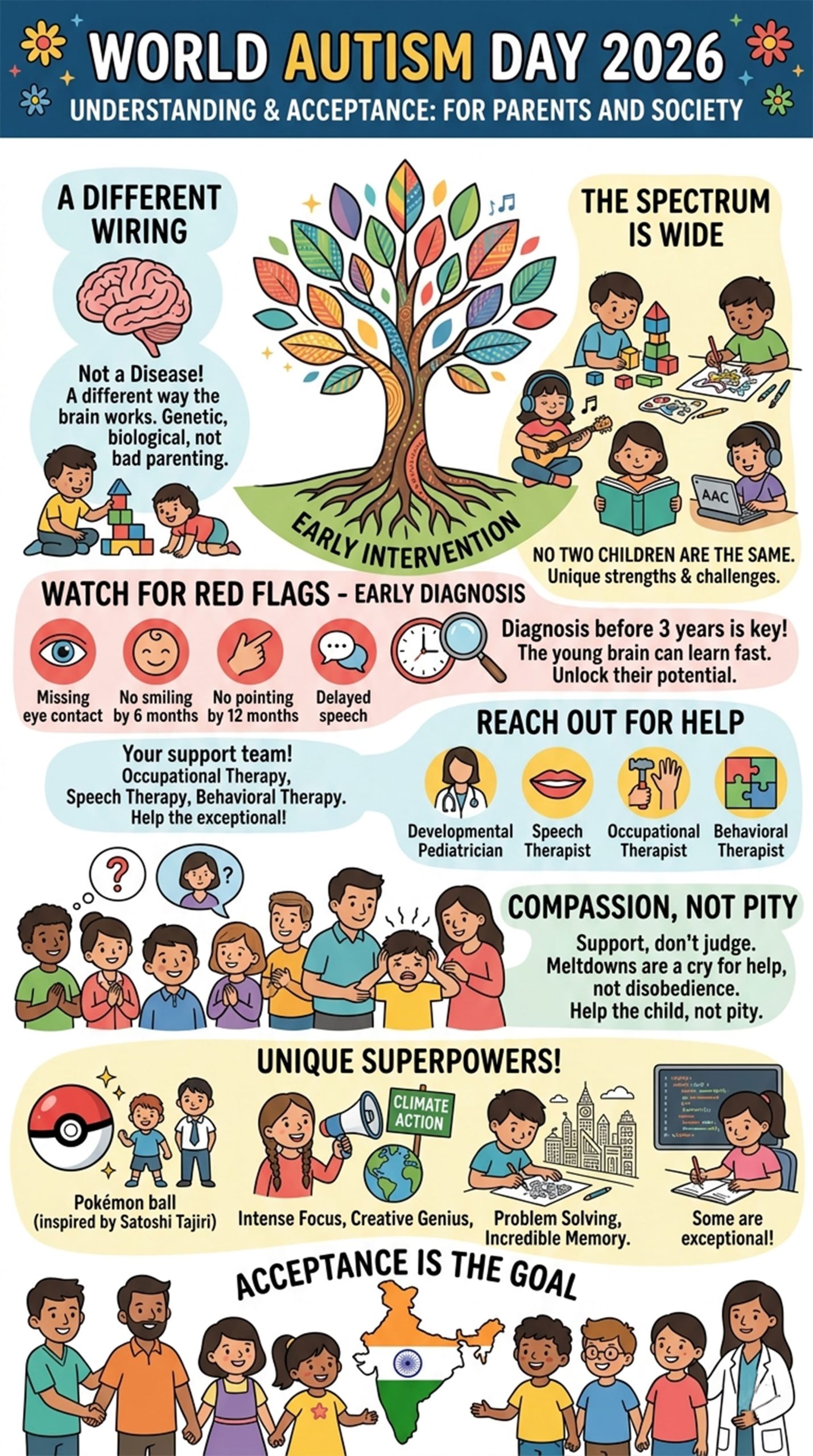
Today, April 2nd, is World Autism Awareness Day. In India, we often hear the word “Autism” whispered in doctors’ waiting rooms or discussed with a “sense of dread”. There is a heavy cloud of stigma, denial, and “what will people say?” hanging over it.
But here’s the truth – “Autism is not a tragedy”.
It is not a disease to be “cured” like a fever. It is simply a different way the brain is wired. Let’s break down the walls of misunderstanding and look at what Autism actually is.
What exactly is Autism?
Autism Spectrum Disorder (ASD) is a developmental condition that affects how a person communicates and interacts with others.
Think of it like a computer: most people run on Windows, but a person with Autism might be running on iOS or Linux. They aren’t “broken”—they just have a different operating system.
The word “Spectrum” is very important. It means that no two people with Autism are the same.
- One child might not speak at all but can solve complex puzzles in seconds.
- Another might talk fluently about space or trains for hours but find it hard to make eye contact or understand a joke.
Why does it happen?
Parents often blame themselves – “Did I look at my phone too much?” or “Is it because of his diet?” Stop. Research shows that Autism is primarily genetic and biological. It starts long before a child is born. It is not caused by bad parenting, vaccines, or “spoiling” a child. It’s just how nature sometimes works.
The Power of “Early”
In our society, we often hear elders say, “Don’t worry, his father also started speaking at age four.” While they mean well, this denial can be harmful.
Early diagnosis (before age 3) is a game-changer. The young brain is very “plastic” – it can learn and adapt quickly. Early intervention doesn’t “fix” the child; it gives them the tools to navigate a world that wasn’t built for them. It also helps parents move from a state of panic to a state of plan.
Red flags to watch for:
- No big smiles or joyful expressions by 6 months.
- No back-and-forth sharing of sounds or facial expressions by 9 months.
- No babbling or “pointing” at things by 12 months.
- Loss of any language or social skills at any age.
Whom to reach out to?
If you feel your child is missing milestones, don’t wait.
- Developmental Pediatrician: Your first point of contact for a formal diagnosis.
- Occupational Therapist (OT): Helps with sensory issues (like being bothered by loud noises or certain textures) and daily life skills.
- Speech & Language Pathologist: Helps the child find their “voice,” whether through words, signs, or pictures.
- Behavioral Therapist: Helps teach social cues and manage challenging behaviors.
Compassion, Not Pity
When we see a child having a “meltdown” at a mall, we often judge. We think the child is “naughty” or the parents are “weak.”
That child isn’t being bad – they are likely overwhelmed. Imagine being in a room where the lights are 10 times brighter and the music is 10 times louder than normal. You’d be upset too!
Shift your perspective: These parents don’t need your pity. They need your compassion. A simple smile of support or asking, “Can I help you with your bags?” means the world to them.
The “Superpowers” within the Spectrum
While Autism brings challenges, it also brings incredible strengths. Many individuals on the spectrum have a “laser focus” and an eye for detail that others miss.
- Satoshi Tajiri: The creator of Pokémon. His childhood fascination with collecting insects (a common autistic trait) led to one of the biggest franchises in history.
- Greta Thunberg: The world-famous climate activist calls her Autism her “superpower” because it helps her see through “business as usual” and focus on facts.
- Exceptional Talents: Some individuals have Savant Syndrome, where they might have a photographic memory, be able to calculate massive prime numbers instantly, or play a complex piano piece after hearing it just once.
Looking Ahead: The Prognosis
“Will my child be okay?” This is every parent’s question.
With the right support, many people with Autism go on to live independent, fulfilling lives. They get jobs, have families, and contribute to society in ways we can’t even imagine. The goal of therapy isn’t to make them “normal” – it’s to make them functional and happy.
This World Autism Day –
Let’s “promise to stop staring and start understanding”.
Let’s replace Awareness with Acceptance.
After all, a garden is beautiful only because it has “many different kinds of flowers”!
Dr. Shivkumar Manvi, Consultant Paediatrician
Dr. Somnath Chatterjee, Medical Director
Prakriya Hospitals, Bengaluru
Further Reading:
- Centre for Disease control: https://www.cdc.gov/autism/about/index.html
- National Institute of Mental Health: https://www.nimh.nih.gov/health/topics/autism-spectrum-disorders-asd
- World Health Organization: https://www.who.int/news-room/fact-sheets/detail/autism-spectrum-disorders
- National Autistic Society (UK): https://www.autism.org.uk/advice-and-guidance/what-is-autism