The 4S strategy: Suggested Blueprint for longevity
As a clinician, I see two types of patients enter their 40s: those who are “coasting” on the fitness of their youth, and those who realize they are entering the most critical decade of their lives.
Our core problem once we enter our 40s is increasing Osteopenia (loss of bone mass) and Sarcopenia (loss of muscle mass). Osteopenia is a greater problem for women who are approaching or have attained menopause.
After 40, our body stops giving us “freebies.” Muscle mass begins its slow, natural decline (sarcopenia), and the structural integrity of our joints becomes a reflection of how we treat them. This advice to you today isn’t about looking good at the beach; it’s about what is called the “Centenarian Decathlon” – training now so that at 80, 90, or 100, we can still pick up your grandkids, carry our own groceries, and get up off the floor without help.
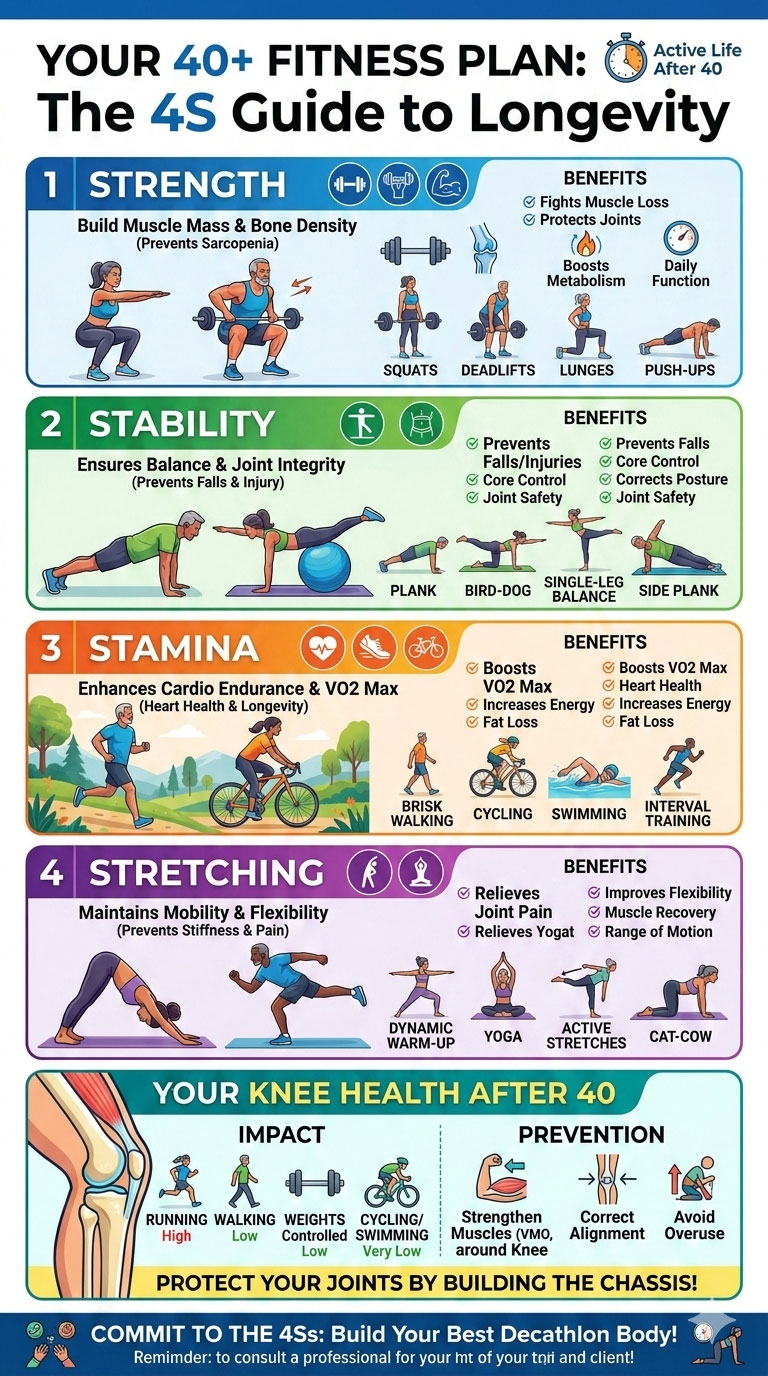
To do this, we must look at the 4 Ss of Exercise: Strength, Stability, Stamina, and Stretching. Let’s break down the most common modalities and see how they stack up for the 40+ body.
1. Walking: The Foundation of Life – Essential, but insufficient.
- The Advantage: It builds baseline cardiovascular health and keeps the lymphatic system moving. For the knee, it is relatively safe and provides necessary joint lubrication.
- The Disadvantage: It lacks the intensity to significantly improve stamina or build the bone density and muscle (strength) required to combat aging.
- Impact on Knees: Very low. Great for recovery days, but won’t “bulletproof” the joint.
2. Running: The High-Octane Risk – Great for the heart, taxing on the “chassis.”
- The Advantage: Excellent for Stamina. Running provides a high metabolic return in a short amount of time.
- The Disadvantage: For those over 40, running is often where “old injuries” come back to haunt us. It requires high Stability—if our hips or core are weak; our knees will pay the price.
- Impact on Knees: High. Without supplemental strength training, many 40+ runners eventually face meniscus wear or “runner’s knee.”
3. Cycling: The Cardio King – Efficient and joint-friendly, but one-dimensional.
- The Advantage: Fantastic for building aerobic Stamina with almost zero impact. It’s the safest way to get our heart rate up if we already have joint issues.
- The Disadvantage: It is a “closed-chain” repetitive motion. It does nothing for bone density (because it’s non-weight bearing) and can lead to tight hip flexors and poor posture.
- Impact on Knees: Low, provided our bike fit is correct. However, it lacks the variety of movement needed for Stability.
4. Swimming: The “Weightless” Alternative – Excellent for therapy, but lacks structural “load.”
- The Advantage: Great for Stamina and Stretching (mobility). It utilizes the whole body and is the “gold standard” for rehab because it removes gravity from the equation.
- The Disadvantage: Like cycling, it doesn’t build bone density. After 40, we need gravity to keep our bones strong.
- Impact on Knees: Negligible. Best for those with severe arthritis.
5. Weight Training: The Non-Negotiable Pillar – The “Gold Standard” for the 40+ athlete
If one could only prescribe one modality, this is it.
- The Advantage: It hits all 4 Ss. It builds Strength to protect joints, requires Stability to move loads, improves Stamina (when done with intensity), and requires Stretching (mobility) to perform full ranges of motion.
- The Knee Factor: Many of us fear weights because of our knees. In reality, controlled resistance training (squats, lunges, step-ups) strengthens the muscles around the knee, actually reducing joint pain and preventing injury.
- The Clinician’s Secret: Muscle is our “longevity currency.” We cannot “walk” your way to more muscle; we must earn it through resistance.
Prescription: The “4 S” Strategy – here is how you should structure your week to thrive after 40
- Strength (2–3 days/week): Focus on compound movements. Think “functional” – pulling, pushing, and lifting things from the floor. This is your insurance policy against frailty.
- Stability (Every day): This is the “forgotten S.” Balance on one leg while brushing your teeth. Do core work that prevents your spine from moving (anti-rotation). Stability is what prevents the falls that become “life-ending” in later decades.
- Stamina (3–4 days/week): Mix low-intensity “Zone 2” (brisk walking/easy cycling) with one day of high-intensity intervals to keep your heart’s engine young.
- Stretching/Mobility (Daily): Not just passive holding, but active mobility. If you can’t move your joints through their full range, you are an injury waiting to happen.
Final Thoughts:
At 40, we aren’t “old,” but we are no longer “new.” The best modality isn’t just one; it’s a strength-first approach supplemented by cardio. Stop exercising to “lose weight” and start training for the 80-year-old version of ourselves. Our knees, our heart, and our future self will thank us.
Dr. Somnath Chatterjee
MBBS,MD, FRCA, CCST, EDIC, FFICM
Consultant – Anaesthesia & Intensive Care