A City That Belongs to No One
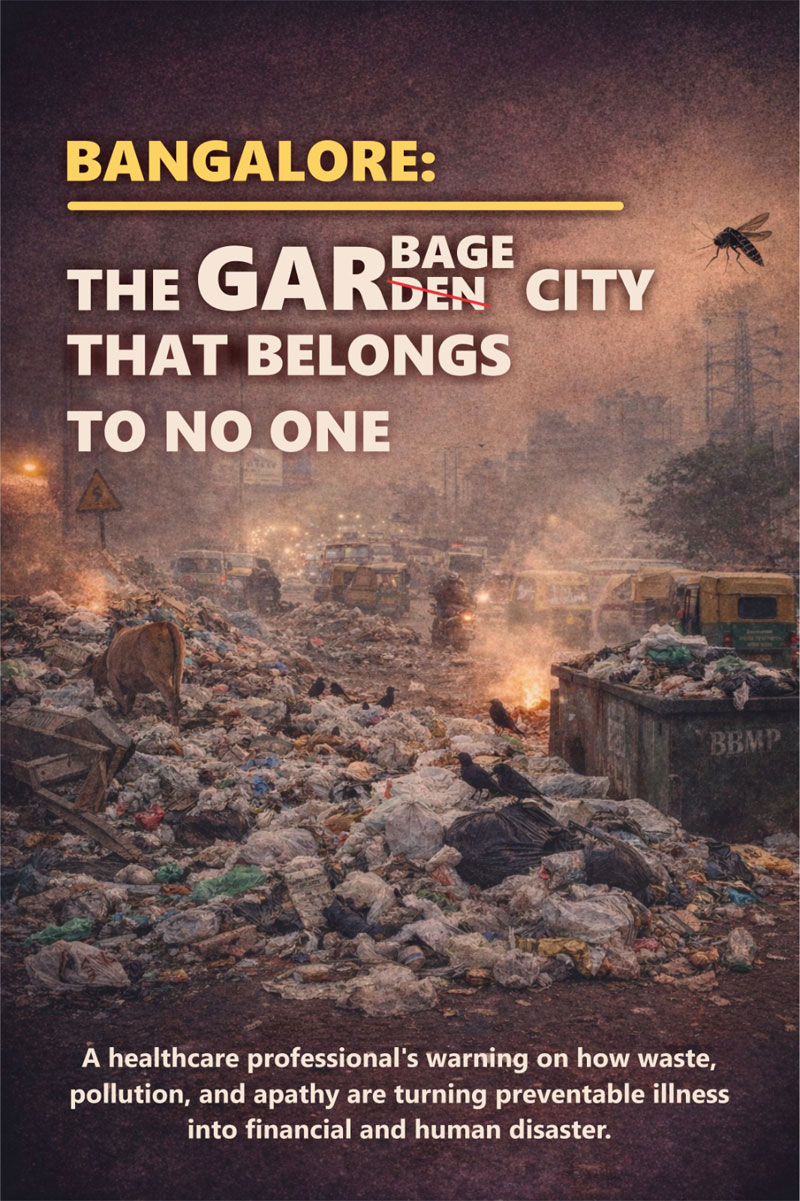
Bangalore is everyone’s favourite city to migrate to. The weather is forgiving. Jobs are abundant. Salaries are better. Opportunities feel endless. People arrive here with ambition and hope. Yet I want to ask all of us—residents and authorities alike—one uncomfortable question: whom does this city belong to? Today, the honest answer is—no one. And that is exactly why Bangalore looks the way it does.
If Bangalore truly felt like our city, our home, would we tolerate garbage dumped on roadsides, plastic choking drains, overflowing bins outside homes, schools, and hospitals? Would we accept stagnant water breeding mosquitoes? Would we walk past filth every day and call it “normal”? We would never allow our own homes to look like this. Yet we allow our shared home to decay.
I speak as a resident, a healthcare professional, and a deeply concerned citizen. Every day, I see the price of this apathy – not in abstract numbers, but in real families. Dengue, malaria, viral fevers, leptospirosis, heart attacks and asthma exacerbations triggered by pollution. These are not rare events anymore. They are routine. And they are devastating. We can no longer deny that this ruins families.
A single hospital admission for dengue or severe viral fever in Bangalore today can easily cost ₹60,000 to ₹1.5 lakh in a private hospital. If the illness worsens and requires an ICU stay, the cost rapidly escalates to ₹3–8 lakh, sometimes more, depending on duration and complications. This does not include medicines after discharge, follow-up visits, or long-term weakness that prevents a return to work. These expenses also do no guarantee survival.
Now add loss of income. A daily wage worker, auto driver, delivery executive, or small business owner may lose ₹1,000–2,000 per day. Two to three weeks of illness means ₹20,000–40,000 gone instantly. For salaried employees without paid leave or job security, the impact is similar or worse.
And when illness leads to death, the financial impact is catastrophic and permanent. Funeral costs, hospital bills, outstanding loans and loss of the primary income earner. This can translate into a lifetime loss running into crores, especially when children’s education and long-term earning potential are affected. Families often never fully recover.
A significant portion of this suffering is avoidable.
Blocked drains, unsegregated waste, unmanaged garbage, polluted air and man-made and are not inevitable. We create the conditions, and then we pay the price in hospitals, ICUs, and funeral homes.
Garbage is not the only silent killer. Air pollution in Bangalore is steadily worsening. Vehicular emissions, construction dust, burning of waste, and traffic congestion are directly contributing to asthma, heart disease, strokes, and premature deaths. Children and the elderly pay the highest price.
What can we do – practically and immediately?
As citizens, we must reduce dependence on private vehicles wherever possible. Public transport is not a punishment; it is a public health intervention. Using buses, metro, carpooling, walking short distances, and cycling where feasible directly reduces pollution, traffic stress, and healthcare burden. Refusing to burn garbage, questioning construction dust control, and demanding cleaner fuel policies are equally important.
And to our civic authorities, this is a direct challenge: where is our garbage tax going? Where is the accountability for waste management, drainage maintenance, and air quality control? Why do we prepare after outbreaks instead of preventing them? Why must citizens suffer illness and financial ruin before action is taken?
To residents, I request politely: treat Bangalore like your home, not a hotel. Segregate waste. Stop littering. Take responsibility for your street and neighbourhood. Organize, question, and demand better. A city improves only when its citizens refuse to accept decay as normal.
To civic authorities, leadership is not about statements. It is about outcomes. Clean streets, functioning drains, reliable waste collection, breathable air. This is not charity. This is your mandate and responsibility.
Bangalore can change. It must change. But only if we collectively reject the idea that this problem belongs to someone else. Health is wealth—but only if we live like we believe it.
Bangalore belongs to all of us, or it will continue to belong to no one. The time for action is not tomorrow. The time for action is now.
Dr. Somnath Chatterjee
Medical Director, Prakriya Hospitals
Bangalore